Monday, April 15, 2013

Atlantis in Mexico, 2 edition

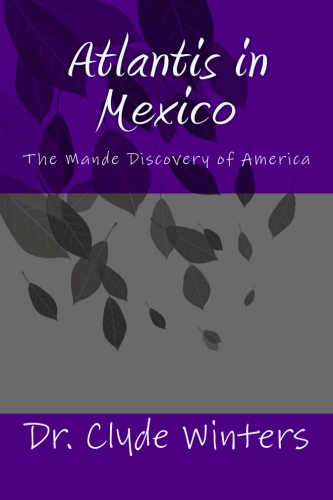
I have just republished my book Atlantis in Mexico. This is a revised edition of my 2005 book. In the new edition I have included chapters on the Olmec Calendar and  King BiPo who's obituary is written on Cascajal stela.


Clyde Winters, PhD in this revised edition of Atlantis in Mexico gives us a history of the magnificent Olmec civilization founded by African explorers in Mexico. The Olmec civilization is recognized by many archaeologists as the “Mother Culture” of Mexico.


In this book Dr. Winters discusses the rise of the first civilization in Mesoamerica. He explains how the Olmec originated in Africa, sailed to the Gulf of Mexico, built pyramids and introduced writing to the Maya. . In the latest edition of this book Dr. Winters provides a translation of the Cascajal stela, and Olmec calendrics.


You can order the book at Createspace e-Store

Friday, April 12, 2013

Meroitic Writing and Literature


Check out my latest book


In Meroitic Writing and Literature is divided into three parts. The first part of the book explains how I used the Kushana hypothesis to completely decipher the Meroitic script. It will outline the Classical literature that informed my decipherment of Meroitic and how Buddhists early settled in Upper Egypt and the Meroitic Empire and spread their religion and writing system: Tocharian.


In Part two we outline the grammar of Meroitic. It will provide readers with a detailed overview of the Meroitic language and its grammar.

Part Three provides translations of key Meroitic. These texts provide knowledge of the lifeway’s of the Meroites especially their religion and some historical data.

The Meroitic literature discussed in this book include : The Inscriptions of Tanyidamani; The Meroitic Chamber Inscription of Philae; and Meroitic Evidence for a Blemmy Empire in the Dodekaschoinas. These text were chosen because they include text written in archaic Meroitic (Tanyidemani), and other text written in late Meroitic.

Meroitic Writing and Literature, is the first account of the Meroitic language and literature. It will allow readers the opportunity to learn how to read/decipher Meroitic text, while acquiring an intimate knowledge of the Meroites as individuals.


Order book at Createspace e-Store


Monday, April 8, 2013

I have just published a new book on the ancient Egyptians.

Using genetic, anthropological, linguistic and historical evidence Dr. Clyde Winters explains that ancient Egypt was a multiethnic society in which each of the 42 sepats or nomes (Egyptian administrative centers) was dominated by a different ethnic group, who probably spoke various Niger-Congo languages. It illustrates that because Egypt was a multi-ethnic and multi-lingual society the ancient Egyptian language is related to languages spoken in Black Africa. Egyptian Language: The Mountains of the Moon, Niger-Congo Speakers and the Origin of Egypt illustrates that because of the existence of each sepat originally as an independent state meant that once the sepats were united into Kemit, Egyptian scholars were forced to create a lingua franca to provide the Egyptian people with a single means of communication for governmental, religious, intellectual and commercial purposes. The genetic relationship between ancient Egyptian and Black African languages make it clear that ancient Egypt or Kemit was a Pan-African civilization and that the Egyptian language is a link language used to unite the regional languages formerly spoken in the sepats of ancient Egypt.

You can order the book at:


Before Egypt: The Maa Confederation, Africa's first Civilization

By my new book on the first great civilization of Africa titled: Before Egypt: The Maa Confederation, Africa's First Civilization.

European researchers asked Africans if a great civilization formerly existed in Africa and they were told yes. The name they gave this great civilization was Maa.


In this book Dr. Clyde Winters will discuss the history and anthropology of Africa’s first civilization : The Maa Confederation. The Maa Confederation was the original homeland of the Egyptians, Mande, Sumerians , Elamites and Dravidian speaking people. I call these people Proto-Saharans or Maaites. They worshipped Seth and Amon/Amma.


Dr. Clyde Winters is an anthropologist and educator. He has taught Education and Linguistic courses at Governors State University and Saint Xavier University-Chicago.

You can order the book from 


African Empires in Ancient America

Please order my latest book on Blacks in Ancient America. The book is called :African Empires in Ancient America.

African Empires in Ancient America tells the story of the numerous African groups who colonized Mexico, North and South America. Today most people believe that African people never voyaged outside Africa except as slaves. This is false, the Dafuna boat discovered in Nigeria dates back to 12,000 BC. And hundreds of ancient African boats have been engraved on rocks in the Sahara desert.


Boats from Magan (Egypt) and Meluhha (Kush-East Africa) are mentioned in Sumerian cuneiform text. In this book you will discover that Africans have a long tradition of sea exploration and founded many of the major American civilizations.


Although many people have heard about the possible discovery of America by Mansa Abubakari of the Mali Empire, and the giant Olmec heads of Mexico, Dr. Clyde Winters gives a detailed account of the Malian colonies established by these West Africans in North America and Brazil.


You will discover the role of the Xi, or Olmec people as the Mother Culture of Mexico. Dr. Winters outlines the Axumite discovery of America, and the role of the Ethiopians in the rise of Mochica civilization and religion. In addition, this book discusses the ancient Sumerian influence in South America, and the African role as Mound Builders in the United States. African Empires in Ancient America is the only book that finally explores the history of Black colonization of the Americas before Columbus. It is a must read for anyone interested in a true history of America.  You can order the book from


The Meroitic Language

Check out my latest Book: The Meroitic


The Meroitic Language, provides a detailed account of the language of the Kushites who founded the Meroitic Empire. In Meroitic Language, Dr. Winters explains his decipherment of the Meroitic language and provides an outline of the grammar of the Meroitic language.


Meroitic language provides readers with the necessary tools to read the Meroitic inscriptions.It also gives the reader key insight into the culture and religion of the Kushites.


Meroitic Language can be purchased at Scribd. Purchase the full version and...

• Read the full version in your browser

• Send to mobile device

• Download as pdf (PDF)

• Download as txt (Text file)


The cost of Meroitic Language is $4.99.


Scribd: http://www.scribd.com/doc/112999049/Meroitic-Language

Thursday, August 23, 2012

Did Haplogroup R1 Originate in Africa ?


In a new article on the R1 clade, The genetic landscape of Equatorial Guinea and the origin and migration routes of the Y chromosome haplogroup R-V88 Gonzalez et al, argue that R1 probably spread across Europe from Iberia to the east given the distribution of R1 in Africa.

In my paper POSSIBLE AFRICAN ORIGIN OF Y-CHROMOSOME R1-M173:here ;

I argue that the P clade originated in Africa because 1) the age of R-V88 and 2) the widespread nature of R1 in Africa. Researchers have found that the TMRCA of V88 was

9200-5600 kya (Cruciani et al, 2010). Eurasians carry the M269 (R1b1b2) mutation. The subclades of R1b1b2 include Rh1b1b2g (U106) (TMRCA 8.3kya) and R1b1b2h (U152) (TMRCA 7.4kya). The most recent common ancestor for R1b1b2 in Europe is probably 8kya (Balaresque et al, 2010). Y-Chromosome R1b1b2 has high frequencies in England, France, Italy and Germany (Balaresque et al, 2010). Clearly, R-V88 is older than R-M269 .


The new article by Gonzalez et al adds further support to my theory. The researchers propose that the R haplogroup did not spread from East Africa.


Article

European Journal of Human Genetics advance online publication 15 August 2012; doi: 10.1038/ejhg.2012.167


The genetic landscape of Equatorial Guinea and the origin and migration routes of the Y chromosome haplogroup R-V88


Advance online publication 15 August 2012
Abstract


Human Y chromosomes belonging to the haplogroup R1b1-P25, although very common in Europe, are usually rare in Africa. However, recently published studies have reported high frequencies of this haplogroup in the central-western region of the African continent and proposed that this represents a ‘back-to-Africa’ migration during prehistoric times. To obtain a deeper insight into the history of these lineages, we characterised the paternal genetic background of a population in Equatorial Guinea, a Central-West African country located near the region in which the highest frequencies of the R1b1 haplogroup in Africa have been found to date. In our sample, the large majority (78.6%) of the sequences belong to subclades in haplogroup E, which are the most frequent in Bantu groups. However, the frequency of the R1b1 haplogroup in our sample (17.0%) was higher than that previously observed for the majority of the African continent. Of these R1b1 samples, nine are defined by the V88 marker, which was recently discovered in Africa. As high microsatellite variance was found inside this haplogroup in Central-West Africa and a decrease in this variance was observed towards Northeast Africa, our findings do not support the previously hypothesised movement of Chadic-speaking people from the North across the Sahara as the explanation for these R1b1 lineages in Central-West Africa. The present findings are also compatible with an origin of the V88-derived allele in the Central-West Africa, and its presence in North Africa may be better explained as the result of a migration from the south during the mid-Holocene.


Keywords:


Central-West Africa; Equatorial Guinea; human male lineages; Y chromosome; haplogroup R-V88; back to Africa hypothesis


The Gonzalez et al article is further proof of the African origin for y-chromosome R1’ The researchers found that 10 out of 19 subjects in the study carried R1b1-P25 or M269. This is highly significant because it indicates that 53% of the R1 carriers were M269. the finding is further proof of the widespread nature of this so-called Eurasian genes in Africa among populations that have not mated with Europeans.


Gonzalez et al proposes a West to East spread for P-25, with a possible entry of this clade via Gibraltar.

.