
The Meroitic script is almost identical to many of the Kharosthi signs used to write Tocharian. It is interesting to note that over seven of the Kharosthi and Meroitic signs have not only similar shape, but also the same sound.
Griffith (1911a) has divided the Meroitic writing into two different forms according to the shape of Meroitic signs at various points in history. The two stages of Meroitic writing were called Archaic and late. In deciphering Meroitic inscriptions it is important that you refer to Giffith (1911a) so you can learn how each Meroitic symbol appeared at various stages in the evolution of the Meroitic writing.
Archaic Meroitic dates from the 2nd century BC to the 1st century AD. The Meroitic writing dating from the 1st century AD to the end of the Meroitic Empire is called late Meroitic.
The Meroitic script is almost identical to many of the Kharosthi signs used to write Tocharian. It is interesting to note that over seven of the Kharosthi and Meroitic signs have not only similar shape, but also the same sound.
Griffith (1911a) has divided the Meroitic writing into two different forms according to the shape of Meroitic signs at various points in history. The two stages of Meroitic writing were called Archaic and late. In deciphering Meroitic inscriptions it is important that you refer to Giffith (1911a) so you can learn how each Meroitic symbol appeared at various stages in the evolution of the Meroitic writing.
Archaic Meroitic dates from the 2nd century BC to the 1st century AD. The Meroitic writing from the 1st century AD to the end of the Meroitic Empire is called late Meroitic.
Most of the sounds of the Meroitic and Kharosthi symbols have the same sound. Those Tocharian symbols with different sounds are used to interpret the following Meroitic signs.
Tocharian Meroitic
Ç, s = s
Ş, ś = š
K = q
Ne = :
In this examination of Meroitic we used the transliteration of many Meroitic phonemes proposed by Hintze (1974, 1979) , rather than the entire transliteration system for Meroitic proposed by Griffith (1911). Each Meroitic consonant except when followed by the vowel sign /i/, /o/ and /e/ represents the consonant sound plus the schwa (the
PRONUNCIATION
Front Central
Back
close i (y) (w)
close mid e o
open a
The Meroitic vowels are distinguished by individual signs for i , e , a , o .
There are four Meroitic vowels
/a/, /e/, /i/, and /o/ . There is a neutral vowel sound attached to the Meroitic consonants except for the te and to signs.
The Meroitic vowel sounds are as follows:
e long e sound as in make
a long a sound as in father
i long i sound as in see
o long o sound as in sock
stands for a in asleep
I believe that Meroitic may have two additional vowel sounds. These sounds may be the open mid vowels è and ò. In many African languages we find these vowels.
It therefore stands to reason that they might also occur in Meroitic. I believe that this is proven by the Meroitic script.
In Meroitic we have the /t/ sound represented by . Eventhough we have the /t/ sound and the vowel /e/ and /o/, we also have the signs /to/ and /te/. This suggest that the vowels attached to t-, must have a different sound than the regular /o/ and /e/ sound. If the sounds were not different the Meroites could have just used the signs /to/ and /te/
to write these sounds instead of (to) and (te). I would therefore venture to say the should be pronounced $ tò # and should be pronounced $ tè # in Meroitic
CONSONANTS
There are five syllables in Meroitic ñ , se, te , to and the so-called divider sign (:) -ne represented by separate sounds (Hintze 1974). In this translation of Meroitic each Meroitic syllable without a vowel attached to it is written as a single consonant .
The consonants of Meroitic are as follows:
h kh like the rasping ch: Scottish loch and Bach in German
h ch ich breathy ch, ç
a pronounched like /a/ in father
b as in English
d as in English
i pronounced like /i/ in machine
k pronounced like the /k/ in King
l as in English
m "
n "
p "
r "
s pronounced like /z/ in zoo or /s/ as in rose
s pronounced like the sh in share
t as in English
to pronounced like the to in stole
te pronounced like the te in tea
w pronounced like the /w/ in water
y as in English
q
ñ pronounced like ng as in sing
Meroitic Consonants
Plosive p, b t,d h(kh) k,q h(ch)
Nasal m n ñ
Lateral l
Rolled r
Fricative s s(sh) h(ch)
Semi-vowel w y
I read the Meroitic inscriptions using the lexical items and grammar of the Kushana/Tocharian. To decipher Meroitic I found and read every article I could find in English and French on the Tocharian language. Much of the contempory work on Tocharian is in German, my German is poor so I have concentrated on French and English publications.
Once I learned the Tocharian grammar , I began to collect vocabulary items. These vocabulary items were used to read Meroitic text.
I have been working on Meroitic for a number of years so I have collected many Meroitic terms and published a dictionary of Late Meroitic on-line. A dictionary of Early Meroitic is part of my article on the Incriptions of Tanyidamani.
Showing posts with label Kharosthi script. Show all posts
Showing posts with label Kharosthi script. Show all posts
Wednesday, April 29, 2009

Tuesday, March 10, 2009
Part 5:Winters' Response to Burlak's Meroitic and Tocharian :Tocharian & Kharosthi dates back to 2nd Century
Clyde Winters response to Burlak’s Meroitic & Tocharian Part 5: Tocharian text do not date back to the 2nd Century BC.
4. Burlak argues that Tocharian text do not date back to the 2nd Century BC.
The Tocharian language was written in Kharosthi script. This script was used to write the Gandhararan Buddist Text. According to Glass (2000) the Kharosthi script appears fully developed in the Asokan inscriptions of Shahbazgarhi and Mansehra. These inscriptions date back to 3rd Century BC (Glass, 2000 p.20). It continued to be used in Gandhara, Kushan and Sogdian.
Glass provides evidence that Kharosthi writing dates back to the first Brahmi inscriptions of India (Glass, 2000 pp.20-21). The fact the writing was used in India by Asoka to produce the rock edicts (Glass, 2000) , demonstrates that Khasrothi was in use long before the introduction of the Meroitic script to Kush.
The Meroitic script resembles many Khaorsthi signs. Some researchers argue that the Meroites did not adopt the writing system of the Kushana/Tocharian people which was Kharosthi. Although this is their opinion a comparison of the Meroitic and Kharosthi symbols make it clear that both writing systems share many cognate signs.
Aubin (2003) did a comparison of Meroitic and Kharothi and discovered that 34 out of 42 signs or 81% matched.
Figure 1 : Aubin (2003) Comparison of Meroitic and Kharosthi Signs
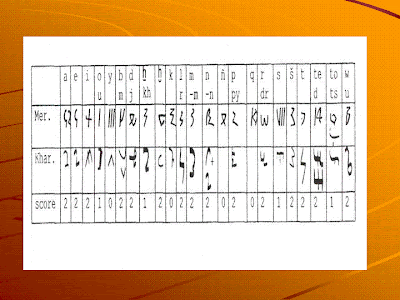
Since Tocharian was written is Kharosthi the cognition between Kharosthi and Meroitic is quite interesting and shows some connection between these scripts. It also offers additional support to the Tocharian origin of Meroitic writing given the analogy between the signs.
Let's not forget that Welsby in The Kingdom of Kush, notes that "only four of the [Meroitic] letters resemble the equivalent Egyptian demotic signs" (p.193) But as you can see from the above there are more than four Kharosthi signs that match Meroitic, and even more of these signs match Kharosthi.
The summary , Kharosthi script dates back to the 3rd Century BC. It was used to write Tocharian inscriptions. This makes it clear that Kharosthi was in use long before the Meroitic script was created.
References:
Aubin,P. (2003). Evidence for an Early Nubian Dialect in Meroitic Inscriptions: Phonological and Epigraphic Considerations. Meroitic Newsletter, pp.16-39.
Glass, A. (2000). A Preliminary Study of Kharosthi Manuscript Paleography. M.A. Thesis. University of Washington.
4. Burlak argues that Tocharian text do not date back to the 2nd Century BC.
The Tocharian language was written in Kharosthi script. This script was used to write the Gandhararan Buddist Text. According to Glass (2000) the Kharosthi script appears fully developed in the Asokan inscriptions of Shahbazgarhi and Mansehra. These inscriptions date back to 3rd Century BC (Glass, 2000 p.20). It continued to be used in Gandhara, Kushan and Sogdian.
Glass provides evidence that Kharosthi writing dates back to the first Brahmi inscriptions of India (Glass, 2000 pp.20-21). The fact the writing was used in India by Asoka to produce the rock edicts (Glass, 2000) , demonstrates that Khasrothi was in use long before the introduction of the Meroitic script to Kush.
The Meroitic script resembles many Khaorsthi signs. Some researchers argue that the Meroites did not adopt the writing system of the Kushana/Tocharian people which was Kharosthi. Although this is their opinion a comparison of the Meroitic and Kharosthi symbols make it clear that both writing systems share many cognate signs.
Aubin (2003) did a comparison of Meroitic and Kharothi and discovered that 34 out of 42 signs or 81% matched.
Figure 1 : Aubin (2003) Comparison of Meroitic and Kharosthi Signs

Since Tocharian was written is Kharosthi the cognition between Kharosthi and Meroitic is quite interesting and shows some connection between these scripts. It also offers additional support to the Tocharian origin of Meroitic writing given the analogy between the signs.
Let's not forget that Welsby in The Kingdom of Kush, notes that "only four of the [Meroitic] letters resemble the equivalent Egyptian demotic signs" (p.193) But as you can see from the above there are more than four Kharosthi signs that match Meroitic, and even more of these signs match Kharosthi.
The summary , Kharosthi script dates back to the 3rd Century BC. It was used to write Tocharian inscriptions. This makes it clear that Kharosthi was in use long before the Meroitic script was created.
References:
Aubin,P. (2003). Evidence for an Early Nubian Dialect in Meroitic Inscriptions: Phonological and Epigraphic Considerations. Meroitic Newsletter, pp.16-39.
Glass, A. (2000). A Preliminary Study of Kharosthi Manuscript Paleography. M.A. Thesis. University of Washington.
Subscribe to:
Posts (Atom)