Wednesday, June 7, 2017

Schlebusch et al (2017) argue that the Khoisan carry 9-22% Eurasian Genes

Schlebusch et al (2017), claim that " all modern-day Khoekhoe and San groups have been influenced by 9-22% genetic admixture from East African/Eurasian pastoralist groups arriving >1,000 years ago, including the Ju|'hoansi San, previously thought to have very low levels of admixture ". This is ludicrous, there is no archaeological evidence, presented by these researchers of East Africans migrating into south Africa, we only have the Bantu speakers expanding into Southern Africa during the Iron Age. As I note in my Protocols to Evaluate genetics articles the absence of archaeological support is a clear sign the paper lacks any validity (web page). 


Schlebusch et al (2017) has it backwards. The so-called Eurasian admixture among the Khoisan is the result of the spread of khoisan into Eurasia, as the Cro-Magnon carriers of the Aurignacian civilization. Boule, M., H V Vallois in Fossil Man link the San people and the Aurignacians who are labled today Cro-Magnon.


The Khoisan formerly occupied an area from South Africa to North. This would explain the Khoisan domesticated cattle being of North African rather than Bantu type.
The most archaic AMH remains come from Florished, South Africa; they date between 190-330 kya. Other ancient fossil evidence of AMH in South Africa come from Broken Hill (c.110kya) and the Klasis River caves (c. 65-105kya).


The Khoisan early migrated into North Africa. As a result, we see shared cultural and behavioral traditions between 200-40kya among South Africans and Moroccans.


KHOISAN


 -

The Khoisan carry haplogroups L3(M,N). Before they reached Iberia, they probably stopped in West Africa.
Granted L3 and L2 are not as old as LOd, but Gonder et al (2006)provides very early dates for this mtDNA e.g., L3(M,N) 94.3; the South African Khoisan (SAK) carry L1c, L1,L2,L3(M,N) dates to 142.3kya; the Hadza are L2a, L2, L3(M,N), dates to 96.7kya.
The dates for L1,L2,L3, M,N are old enough for the Khoisan to have taken N to West Africa, where we find L3, L2 and LOd and thence to Iberia as I suggested in my paper (Winters,2011).
It is interesting to note that LO haplogroups are primarily found among Khoisan and West Africans. This shows that at some point in prehistory the Khoisan had migrated into West Africa on their way to Morocco.
The basal L3(M) motiff in West Africa is characterized by the Ddel site np 10394 and Alul site np 10397 associated with AF-24. This supports my contention that Khoisan speakers early settled West Africa on their way to Iberia.
The Khoisan may have introduced the L haplogroup to Iberia. The SAK populations carry haplogroups L2, and L3. Dominguez (2005) ,noted that much of the ancient mtDNA found in Iberia has no relationship to the people presently living in Iberia today and correspond to African mtDNA haplogroups .
The SAK carry haplogroups L1c, L1,L2,L3 M,N and dates to 142.3kya; the Hadza are L2a, L2, L3, M,N, and dates to 96.7kya.
The dates for L1,L2,L3(M,N) are old enough for the Khoisan to have taken N to West Africa and thence Iberia.
Dominguez (2005) found that the lineages recovered from ancient Iberian skeletons are the African lineages L1b,L2 and L3. Almost 50% of the lineages from the Abauntz Chalcolithic deposits and Tres Montes, in Navarre are the Sub-Saharan lineages L1b,L2 and L3. The appearance of phylogenetically related sequences of hg L3 present in many ancient Iberian skeletons suggest that this haplogroup may have a long history in Iberia. This would support the possibility that SAK populations early settled ancient Iberia.

The Neanderthal used Mousterian tools. These tools were also being used in Africa as early 130kya. This places Neanderthalers in North Africa.
The human types associated with the Neanderthal tools found at Jebel Ighoud and Haua Fteah resemble contemporaneous European Neanderthaler tools. The presence of Mousterian tools suggest that Neanderthalers mixed with Africans because we know that anatomically modern humans were living in the area at the time.

The African Neanderthal people used the common Levoiso-Mousterian tool kit originally discovered in Europe. The Nenderthal skeletons have come from Djebel Irhoud and El Guettar in Morocco (Ki-Zerbo,1981). Later Neanderthal people used the Aterian tool kit. It was probably in Morocco that Neanderthal and Khoisan interacted.
An exception to this norm are the Khoisan who share a phylogenic relationship with Altai Neanderthals (Prufer, et al, 2013). Many researchers claim that Africans have no relationship to the Neanderthals.But Prufer et al (2013) share more alleles with Altaic Neanderthal than Denisova.
In the Supplemental section of Prufer et al (2013) there is considerable discussion of the relationship between Neanderthal and Khoisan. In relation to the Altaic Neanderthal the non-Africans have a lower divergence rate than Africans between 10-20%. Prufer et al (2013) note little statistical difference between non-African and African divergence.
Researchers have observered a relationship between the Neanderthals, the Khoisan and Yoruba. Prufer et al (2013) detected a relationship between the Neanderthal and Mandekan. It is interesting to note that Yoruba traditions place them in Mande-speaking areas (Prufer et al,2013).
There is interesting information in Figure S7.1. In Figure S7.1 the maximum likelihood tree of bonobo, Denisova and Neanderthal, the closest present-day hmans are Africans, not Europeans. Reading the Tree Chart Graph, the neighbor joining tree of archaic and present day human individuals has the Khoisan following the Denisova.
An interesting finding of Prufer et al (2013) was that Altaic Neanderthal and Denisova are estimated to have similar split times. The divergence estimate for African Khoisan-Mandekan and Altaic is younger than the split between Africans and Denisova archaic individuals and modern African individuals. The split times between the Khoisan and Mandekan may be explained by the presence of AF-24 haplotype in West Africa.
The major problem with the paper is that the Prufer et al (2013)believe that there was a back-to-Africa migration of Eurasian genomes among West Africans people. This back migration probably did not occur. What we do know is that the ancient Kushite people belonged to the C-Group. The C-Group people spoke Niger-Congo and Dravidian languages.
The Kushites founded many civilizations in Eurasia including the Sumerian and Elamite civilizations. The Kushites may have spread L3(M) and y-chromosome R haplogroup in Eurasia. This suggest that so-called Eurasian genomes are the result of admixtures of Europeans and Kushites.
In summary the Khoisan early settled Morocco. From here they interacted with Neanderthal populations. Later the Khoisan migrated into Iberia an deposited many genomes of the L clade and L3(N) macrohaplogroup.

The Khoisan took the Aurignacian culture to Europe from North Africa.

 -

The craniofacial evidence makes it clear that the Aurignacian people came from Africa . The Aurignacian people are called Grimaldi Or Cro-Magnon.


Boule and Vallois, note that "To sum up, in the most ancient skeletons from the Grotte des Enfants we have a human type which is readily comparable to modern types and especially to the Negritic or Negroid type" (p.289). They continue, "Two Neolithic individuals from Chamblandes in Switzerland are Negroid not only as regards their skulls but also in the proportions of their limbs. Several Ligurian and Lombard tombs of the Metal Ages have also yielded evidences of a Negroid element.

Since the publication of Verneau's memoir, discoveries of other Negroid skeletons in Neolithic levels in Illyria and the Balkans have been announced. The prehistoric statues, dating from the Copper Age, from Sultan Selo in Bulgaria are also thought to portray Negroids.

In 1928 Rene Bailly found in one of the caverns of Moniat, near Dinant in Belgium, a human skeleton of whose age it is difficult to be certain, but seems definitely prehistoric. It is remarkable for its Negroid characters, which give it a reseblance to the skeletons from both Grimaldi and Asselar (p.291).

Boule and Vallois, note that "We know now that the ethnography of South African tribes presents many striking similarities with the ethnography of our populations of the Reindeer Age. Not to speak of their stone implements which, as we shall see later , exhibit great similarities, Peringuey has told us that in certain burials on the South African coast 'associated with the Aurignacian or Solutrean type industry...."(p.318-319). They add, that in relation to Bushman art " This almost uninterrupted series leads us to regard the African continent as a centre of important migrations which at certain times may have played a great part in the stocking of Southern Europe. Finally, we must not forget that the Grimaldi Negroid skeletons sho many points of resemblance with the Bushman skeletons". They bear no less a resemblance to that of the fossil Man discovered at Asslar in mid-Sahara, whose characters led us to class him with the Hottentot-Bushman group."

 -

in conclusion, the Khoisan carry Eurasian genes, not because of admixture. They carry Eurasian genes because they were the first Eurasians.


Sources:

Boule, M., HV Vallois . (1957). Fossil Man . Dryden Press New York

Barral,L. & Charles,R.P. (1963) Nouvelles donnees anthropometriques et precision sue les affinities systematiques des negroides de Grimaldi, Bulletin du Musee d’anthropologie prehistorique de Monaco, No.10:123-139.
Reference:

de Domínguez E.F. Polimorfismos de DNA mitocondrial en poblaciones antiguas de la cuenca mediterránea. Universitat de Barcelona. Departament Biologia Animal, 2005 (PhD thesis).

Gonder MK, Mortensen HM, Reed FA, de Sousa A, Tishkoff SA. (2006). Whole mtDNA Genome Sequence Analysis of Ancient African Lineages. Mol Biol Evol. 2006 Dec 28.

Ki-Zerbo,J. (1981). Unesco General History of Africa Vol. 1: Methodology and African Prehistory (1981), pg.572.


Pruler,K, Racimo,F.,Patterson,N et al. (2014). The complete genome sequences of Neanderthal from the Altai, Mountains. Nature , 505/7481: 43-9. doi .10.1038/ Nature 12881.Epub.2013.Dec.18.

 Schlebusch C M, Helena Malmström, Torsten Günther, Per Sjödin, Alexandra Coutinho, Hanna Edlund, Arielle R Munters, Maryna Steyn, Himla Soodyall, Marlize Lombard, Mattias Jakobsson. (2017). Ancient genomes from southern Africa pushes modern human divergence beyond 260,000 years ago. bioRxiv 145409; doi: https://doi.org/10.1101/145409


Scozzari, R, Massaia,A, Trombatta,B. et al.(2014). An unbiased resource of novel SNP markers provides a new chronology for human Y-chromosome and reveals a deep phylogenetic structure in Africa. Genome Research, January 6,2014, doi: 10.1101/gr./60785.113.

Verneaux,R: Les Origines de l’humanite. Paris: F. Riedder & Cie, 1926.

Winters C. The Gibraltar Out of Africa Exit for Anatomically Modern Humans. WebmedCentral BIOLOGY 2011;2(10):WMC002311 .http://www.webmedcentral.com/article_view/2311 

Sunday, June 4, 2017

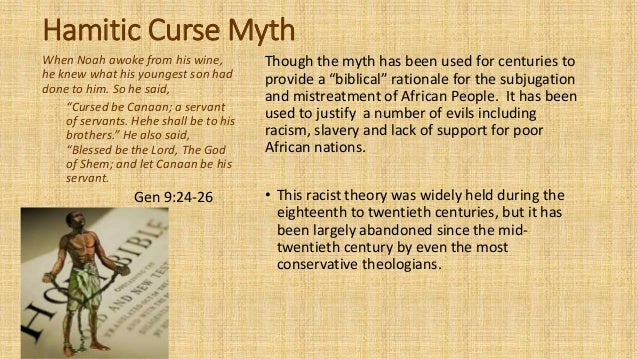
The Geno-Hamitic Theory

The Geno-Hamitic theory is a variation of the Hamitic theory. The term Geno-Hamitic is made up of two words genetics and Hamitic.

Racist used the Hamitic myth in two ways. First it was used by racist to justify the enslavement of Africans, by claiming Black people were cursed.

Image result for hamitic theory

Historians also used the Hamitic myth to explain why great civilizations were found in ancient Africa. The Hamitic theory maintained that there existed in Africa Blacks who had facial features similar to Europeans that were  classified as a subgroup of the Caucasian race. These “black skinned whites” were imagined by 19th Century European scholars responsible for the spread of civilization across Africa.

Geno-hamiticists adhere to the Hamitic theory  claimed that the Kushites and ancient Egyptians , along with Semitic speaking East Africans , and the Fulani are modern representatives of the Hamites.

Although the Hamitic theory has been debunked Geneticists have revived this myth in their studies of African haplogroups. As a result, the East Africans are often referred too in the genetics literature as being distinct from other Sub-Saharan Africans. Sub-Saharan African (SSA)  is the name for the Negro race in modern Genetics articles. The Caucasian and Mongoloid populations are referred too in the Genetics literature, respectively as Western and Eastern Eurasians.


Thusly, we find that Geno-hamiticists imply that East Africans, are distinct from West Africans because, they carry  allegedly Eurasian haplogroups which the Geneticists interpret as evidence of East African and Eurasian admixture. The idea that East Africans carry so-called Eurasian genes due to admixture lacks any historical and/or archaeological support. You see there is no historical and/or archaeological evidence of a back migration of any population to Africa from Eurasia.. In fact as late as 4000 BC, the population in the Levant was Sub-Saharan African, and the archaeological evidence makes it clear the migrations have been of SSA into Eurasia not vice versa.

Given the archaeological and historical evidence the presence of so-called  Eurasian genes among East Africans must be the result, of these genes originating in Africa, not Eurasia.. Moreover, the vast  majority of East Africans carry the same genes carried by the West Africans.

The genomic evidence makes it clear the Geno-Hamitic hypothesis for East africans must be abandoned, while researchers accept the fact that many so-called Eurasian genes evolved in Africa--not Eurasia.

Friday, June 2, 2017

Short History Black People 2


  • There is no monolithic African/Black population. There was a variety of anatomically modern African/Black populations.The four major Black populations were the Australian aborigine , Khoisan, Pygmy and modern African populations found in Ethiopia, East, West and South Africa today. Except for the Australians, remnants of these populations presently live in Africa today.
  • I accept the fact there were ancient Blacks in Asia. These Blacks were the Australian type people who mainly live in Australia and the Hill regions of Oceania.

    The Australians and Veddoids are the original settlers of EurAsia and the Americas (around 100kybp), and may represent members of the first out of Africa migrants. I never refer to these people as Africans, although I do recognize them as Blacks. The Australians were great navigators and probably sailed to Brazil and Crete 100kya

     -   -

    The Bushman/Khoisan probably represent the second African migration of homo sapien sapiens out of Africa. I would class these people with the CroMagnon/Grimaldi group who entered Iberia after 44kybp. Remnants of this great people were found on every continent when Europeans first explored the world.

     -

    The Khoisan introduced the Aurignacian and Salutrean cultures to Europe, and later the Americas.


    The Anu (Pygmy) type were the third migration out of Africa. The Anu began to migrate out of Africa after 20,000 and settled in the Levant which was first settled by Cro Magnon (Khoisan) people who early replaced the Neanderthal folk. The Anu began to replace the Khoisan in many parts of the Americas and Eurasia. It was the Anu who probably first crossed the Beringa straits to enter North America from East Asia.
    The major Anu centers of civilization were the Nile Valley and Mesopotamia. They established major centers of trade in the Americas and Eurasia and exported metals back to the Nile Valley and beyond.
     -
    The Anu are probably the ancestors of the Classical mongoloid people. Classical mongoloids are the Indonesians/Vietnamese/Filipinos and etc. were probably already settled in Anatolia. The classical mongoloids probably constructed Catal Huyuk. The close relationship between Sumerian and the AustroAsiatic languages suggest that the classical Mongoloid people may have also inhabited Mesopotamia by the time the Sumerians entered the area.
    .
     -
    .
    .
    The Natufians would represent the fourth African migration into Eurasia. These Blacks came from East Africa and may represent a Proto-Bantu group.

    After 3500 BC, the Kushite people began to migrant into Eurasia and the Americas. The Great Flood had taken place and many Anu centers were placed under water by the flood.
    The Kushites belonged to the C-Group people of Nubia and the Maa Confederation. The Kushites were Niger-Congo and Dravidian speakers. They had originally belonged to Maa Civilization until aridity caused the Maaites to migrant into the Nile Valley to seek refuge from the dying Saharan zone, which could no longer support human habitation and the Agro-Pastoral lifestyle of the Maaites.
    It appears to have been a natural catastrophe, namely the Great Flood which caused the Classical mongoloids to migrate eastward. We know this because many of the former sites of the Classical mongoloids in Anatolia were occupied by the Kushites (Kaska) people after 3500 BC.
     -


     -

    The Kushites replaced the Anu in Eurasia. Here they re-stablished the lucrative metals trade.
    In Mesopotamia , after 2000 BC, the Gutians began to move out of the Hills and attacked the Semitic speaking Akkadians. Eventually they established a City-State at Lagash.
    In 1400 BC the modern European tribes began to migrate out of Central Asia. They simultaneously began to invade Mesopotamia and India. From bases in Mesopotamia the Indo-Europeans expanded from Central Asia, all the way to the Nile Delta in Egypt.

    By 1200 BC the Classical mongoloids had become well established in East and Southeast Asia. Around this time they conquered the Dravidian people who founded the first Shang empire, and set up a new Shang Empire at Anyang, China. The Classical Mongoloids began to push the Dravidian and Mande speakers out of East Asia

    By 1000 BC the Hau/Han tribes came down from the mountains and pushed the classical mongoloids southward into Yunnan and eventually Southeast Asia. The Han began to make the Yueh and li min people their slaves. The Han often used the Qiang (another Black tribe) as sacrifice victims.
    The Han killed off as many Black tribes as they could. The only thing that saved the Anu or pygmies in East Asia, was the fact that they moved into the mountains in areas they could easily defend from Han attacks.

    This movement of Han and classical mongoloid people southward forced the Kushite/African (Qiang, li min and other African) tribes onto the Pacific Islands. It is these Africans who represent the coastal Melanesians.

    The coastal Melanesians , are descendants of recent African and Dravidian speakers who settled the area after being forced from Asia. The Melanesians belonged to the Lapita culture. They were a combination of Mande, Ethiopian (Naga), and Dravidian speakers.
    The Polynesians/Filipinos and etc. migrated to Islands in the Indian Ocean and Pacific, after the Lapita culture bearers. These people are known as the original Mongoloid people and called Classical Mongoloid in the literature and probably originated in Anatolia or Mesopotamia.

    The Sumerians, Elamites, Xia (of China), Harappans of the Indus Valley and coastal Melanoids are the Proto-Saharan or Maaites of the Maa Confederation. These people were known in History as the Kushites.
    These people originated in the Highland regions of Middle Africa, and began to occupy the former trade centers of the Anu in Eurasia and the Americas. It is for this reason that we find West African placenames in the Pacific and India.

    Given the origin of the classical mongoloids in Anatolia, and the Han Chinese somewhere in North China or Central Asia,the Southeast Asians are not descendants of the first African migration to Eurasia. This is why the Chinese and Classical mongoloid people share few if any genes with the Australians. The Classical mongoloids share genes mainly with the coastal Melanesians who are of African origin, but few genes with the Chinese of East Asia.

Wednesday, May 31, 2017

Eurasian Clades were already carried by Egyptians before Greco-Roman Period

 -


.

The problem with Coconuts/Negroes (people who are brown on the outside, but white inside) is that they don’t understand how to analyze data and form a conclusion. As a result, when they read a paper they accept what is written at face value without looking critically at the data and making their own interpretation.

First of all, Afro-American scholars have accepted that the Egyptians were Black/African people for the past 200 years, i.e., Carter G. Woodson, W.E.B. DuBois, and J.A. Rogers, and the Senegalese scholar Anta Diop ; but, Negro Apologist : Gates, Kittles and etc, spend their time parroting the status quo line that the Egyptians were a mixed race. This same group attempt to make it appear that the Fulani, Somalis and Ethiopians are black skinned whites, because of their facial features. This is stupid, because man originated in Africa, so the physical features of these populations are African features.

The article by Schuenemann et al, 2017 on the Abusir mummies is basically a discussion of the data that support a Greco-Roman origin for Egypt. But the data on the mummies dating between 992-749 BC, can offers us keen insight into haplogroups carried by Egyptians during this time.

The genomic data from this period is important because the people of Abusir at this time would have been primarily Egyptian. As a result, the mtDNA carried by the Egyptians confirms the reality that the so-called Eurasian haplogroups are nothing more than African haplogroups.

In Schuenemann et al, 2017, there were 100 mummies in the study. A total of 27 mummies were dated between 992-749BC. In Figure 1, you can see the clades carried by these Egyptians. Below are the frequencies of the haplogroups among Egyptians at this time:

  • Haplogroup Frequency
    U.......... 18.5
    T.......... 22.2
    J ..........18.5
    X.......... 0.0675
    M1a....... 0.0675
    H ..........0.0675
    I........... 0.0675
    HV......... 0.037
    RO......... 0.037
    K........... 0.037
    N.......... 0.037

The presence of these haplogroups among the Abusir population shows that the U,T, and J clades had a high frequency among the Egyptians, and that many of the so called Middle East clades were already present in Egypt before the Greco-Romans, Turks and etc. ruled Egypt.

In conclusion, the Abusir article provides more data on the African origin of Eurasian mtDNA. We know that these are African clades because there is no evidence of a massive migration of Eurasians into Egypt until the Greco-Roman period as supported by the research in Schuenemann et al.

Reference:

Schuenemann et al., Ancient Egyptian mummy genomes suggest an increase of Sub-Saharan African ancestry in post-Roman periods, Nature Communications 8, Article number: 15694 (2017), doi:10.1038/ncomms15694

Tuesday, April 11, 2017

Afro-American and Native American Shared R1 Y-Chromosomes

There are a number of Y-chromosome Haplogroups shared by mongoloid Native Americas and Afro-Americans.


I can not find any information on V88 among Afro-Americans. But I have found information on the frequency of haplogroup R among Afro-Americans.

.
 -

.
Haplogroup E-P1 is called E1b1a1 .In the Hammer et al (2006) study while 63% of Afro-Americans carry this haplogroup,1.3% Native Americans carry the same haplogroup. 
.
 -

.
The second most frequent Y-chromosome among Afro-Americans is R1b. In the Vallone and Butler (2004) study AAs carried around 0.3% R-M207, and 23% R1b.
.
 -
.
Miller et al (2006) did a detailed study of Afro-American and Native American Y-Chromosome. Miller et al (2006) revealed that NA and AAs share many R haplogroups including R-M17 and R-M207. It is interesting to note that in relation to R-M269, that 21% carried this haplogroup, while 17.0 of AAs carried the same haplogroup. This is interesting because there is very little statistical difference between 17% and 21%.

Sunday, April 9, 2017

Why We Find Discrepancies in African and Non-African Admixture/Structure Studies

We may never know the admixture between Native Americans and Africans if we wait to get the information from researchers because they are attempting to maintain the status quo.

Discrepancies take place because researchers do not want to tell the truth about the genetic histories of African people and their admixture with Native Americans and Eurasians. As a result, researchers have developed methods to exclude evidence of non-Africans carrying haplogroups mtDNA haplogroups L, and y-Chromosomes E and A.


This is due to the protocols of AdMixture and Structure programs that assume that Native Americans, Europeans and Africans only met after 1492. As a result researchers try to find methods to exclude African presence in European and Native Americans so evidence of this admixture will not be evidenced in the final results. Next researchers claim that if African people carry mtDNA haplogroups: N, R, M and D ; and Y-Chromosomes C, Q, I, J, and R, they are carrying Eurasians haplogroups, eventhough all of these haplogroups are found among African populations that have no history of admixture with Europeans. As a result, these haplogroups are probably of African origin--not a back migration.

Researchers believe this evidence should be excluded because any African admixture among these populations have to be recent.
The best example of how African admixture is excluded in research is Reich, D. et al, Reconstructing Native American population history. Nature 488, 370-374 (2012) Paper web page , the method used to exclude African admixture from this study is detailed in Supplementary Material 1.Reich, D. et al (2012) outlines the motivations for the exclusion of Africans from his study:

quote:
  • (i) Motivation
    There were a number of populations for which we did not have access to unadmixed samples. To learn about the history of such populations, we needed to adjust for the presence of non-Native ancestry. We used three complementary approaches to do this. The concordance of results from all these approaches increases our confidence in the key findings of this study.

    (1) Restricting to unadmixed samples: We restricted some analyses to 163 Native American samples (34 populations) without any evidence of recent European or African admixture (Note S2). A limitation of these studies, however, is that we could not analyze 16 populations in which all individuals were inferred to have some degree of recent admixture.

    (2) Local ancestry masking: We identified segments of the genome in each individual that had an appreciable probability of harboring non-Native American or Siberian ancestry. We then created a “masked” dataset that treated genetic data in these sections as missing (Note S4).

    (3) Ancestry Subtraction: We explicitly corrected for the effect of the estimated proportion of European and African in each sample by adjusting the value of f4-statistics by the amount that is expected from this admixture. This is discussed in what follows.

    (ii) Details of Ancestry Subtraction
    Assume that we have an accurate estimate of African and European ancestry for each sample (whether it is an individual or a pool of individuals). In practice, we used the ADMIXTURE k=4 estimates, because as described below, they appear to be accurate for Native American populations (with the possible exception of Aleuts as we discuss below). We can then define:

    a = % African ancestry in a test sample
    e = % European ancestry in a test sample
    1-a-e = % Native ancestry

    For many of our analyses, we are computing f4 statistics, whose values are affected in a known way by European and African admixture. Thus, we can algebraically correct for the effect of recent European or African admixture on the test statistics, obtaining an “Ancestry Subtracted” statistic that is what is expected for the sample if it had no recent European or African ancestry.

    The main context in which we compute f4 statistics is in our implementation of the 4 Population Test, to evaluate whether the allele frequency correlation patterns in the data are consistent with the proposed tree ((Unadmixed, Test),(Outgroup1, Outgroup2)), where the Unadmixed population is a set of Native American samples assumed to derive all of their ancestry from the initial population that peopled America, the Test population is another Native American population, and the two outgroups are Asian populations. An f4 statistic consistent with zero suggests that the Unadmixed and Test populations form a clade with no evidence of ancestry from more recent streams of gene flow from Asia. If the Test population harbors recent European or African ancestry, however, a significant deviation of this statistic from zero would be expected, making it difficult to interpret the results. We thus compute a linear combination of f4 statistics that is expected to equal what we would obtain if we had access to the Native American ancestors of the Test population without recent European or African admixture:

    S_1=(f_4 (Unadmixed,Test;Out1,Out2)-(a) f_4 (Unadmixed,Yoruba;Out1,Out2)-(e) f_4 (Unadmixed,French;Out1,Out2))/(1-a-e) (S3.1)

    Intuitively, this statistic is subtracting the contribution to the f4 statistic that is expected from their proportion a of West African-like ancestry (Yoruba), and their proportion e of West Eurasian-like ancestry (French). We then renormalize by 1/(1-a-e) to obtain the statistic that would be expected if the sample was unadmixed.

    A potential concern is that the African and European ancestry in any real Native American test sample is not likely to be from Yoruba and French exactly; instead, it will be from related populations. However, S1 is still expected to have the value we wish to compute if we choose the outgroups to be East Asians or Siberians. The reason is that genetic differences between Yoruba and the true African ancestors, and French and the true European ancestors, are not expected to be correlated to the frequency differences between two East Asian or Siberian outgroups. Specifically, the allele frequency differences are due to history within Africa or Europe, which is not expected to be correlated to allele frequency differences within East Asia and within Siberia.

    (iii) Ancestry Subtraction gives results concordant with those on unadmixed samples
    To compare the performance of our three approaches to address the confounder of recent European and African admixture, we computed 48 = 8×6 statistics of the form f4(Unadmixed, Test; Han, San). We choose “Unadmixed” to be one of 8 Native American groups from Meso-America southward that have sample sizes of at least two and for which all samples are inferred to be unadmixed by ADMIXTURE k=4 (Chane, Embera, Guahibo, Guaymi, Karitiana, Kogi, Surui and Waunana). We choose “Test” to be one of 8 Native American populations from Meso-America southward with at least two samples that are entirely unadmixed, and that also have at least two samples that have >5% non-Native admixture according to the ADMIXTURE k=4 analysis (Aymara, Cabecar, Pima, Tepehuano, Wayuu and Zapotec1). This allows us to compare results on admixed and unadmixed samples from the same population.

    If the Test population harbors European or West African admixture that we have not corrected, we expect to see a significant deviation of the statistic from zero. For example, f4(Karitiana, French; Han, San), corresponding to the statistic expected for an entirely European-admixed Native American population, is significant at Z = 45 standard errors from zero, and f4(Karitiana, Yoruba; Han, San), which gives the f4-value we would expect for an entirely West African-admixed Native American population, is significant at Z = 101.

    Figure S3.1 shows the scatterplots of Z-scores we obtain without Ancestry Subtraction, with Ancestry Subtraction, and with local ancestry masking (Note S4). The x-axis shows data for the unadmixed samples from each Test population, while the y-axis shows the results for the >5% admixed samples from the same populations. We find that:
    • Without Ancestry Subtraction there are significant deviations from zero (|Z|>3) (Fig. S3.1A)
    • With Ancestry Subtraction, there are no residual |Z|-scores >3 (Figure S3.1B)
    • With local ancestry masking (Note S4), there are again no residual |Z|-scores >3 (Figure S3.1C), showing that this method also appears to be appropriately correcting for the admixture.


Given the exclusion of Africans from studies like Reich, D. et al (2012), means that we are not really knowing the actual admixture among Africans and Native American that carry the accepted African haplogroups: i.e., haploroups E , L and etc.

Tuesday, April 4, 2017

The Basal Europeans were probably Sub-Saharan Africans


It has always been know that the first hunter-gatherers of Europe were  SSAs (Sub-Saharan Africans) . Now we can declare that the carriers of haplogroup R1, that introduced the European agro-pastoral cultures to Europe, i.e., Bell Beaker and Yamnaya were probably also SSAs because they carried V88.

This should not be surprising according to Turek,  the Bell Beaker culture probably began in Morocco. Neolithic migrants into Europe from the Levant were also SSA. Trenton W. Holliday, tested the hypothesis that if modern Africans had dispersed into the Levant from Africa, "tropically adapted hominids" would be represented in the archaeological history of the Levant, especially in relation to the Qafzeh-Skhul hominids.  This researcher found that the Qafzeh-Skhul hominids (20,000-10,000),were assigned to the Sub-Saharan population, along with the  Natufians samples (4000 BP). Holliday also found African fauna in the area. If they were Sub-Saharan Africans in the Levant.


Toomas Kivisild1 (2017).The study of human Y chromosome variation through ancient DNA. web page provides a detailed discussion of R1 in prehistoric Europe.

The article is interesting. It is most interesting because it places V88 in ancient Europe. It is sad that researchers fail to publish this reality.


Kivisild (2017) also made it clear that V88 is the earliest offshoot of R-M343 .
quote:


Late Neolithic, Early Bronze Age and Iron Age samples from Central and Western Europe have typically the R1b-L11, R1a1-Z283 and R1a-M417 (xZ645)
affiliation while the samples from the Yamnaya and Samara neighbourhood are different and belong to sub-clades R1b11-Z2105 and R1a2-Z93 (Allentoft et al. 2015; Cassidy et al. 2016; Haak et al. 2015; Mathieson et al. 2015; Schiffels et al. 2016).


 -


The R1b11-Z2015 lineage is today common in the Caucasus and Volga-Uralic region while being virtually absent in Central and Western Europe (Broushaki et al.2016). Interestingly, the earliest offshoot of extant haplogroup R1b-M343 variation, the V88 subclade, which is currently most common in Fulani speaking populations in Africa (Cruciani et al. 2010) has distant relatives in Early Neolithic samples from across wide geographic area from Iberia, Germany to Samara (Fig. 7).


The presence of the carriers of V88 in Europe makes it clear that Sub-Saharan Africans had been in Europe for an extended period of time. Moreover it is clear that 25kya SSAs carrying haplogroup R1 were in Eurasia, Africa and the Americas.
.

 -

The Basal Eurasians that are mixed into modern Europeans, who came from the Middle East, and North Africa were SSA's not Indo-European speakers.
.


quote:


Interestingly, the earliest offshoot of extant haplogroup R1b-M343 variation, the V88 sub-clade, which is currently most common in Fulani speaking populations in Africa (Cruciani et al. 2010) has distant relatives in Early Neolithic samples from across wide geographic area from Iberia, Germany to Samara (Fig. 7).


This quote makes it clear the V88 sub-clade, had relatives in Early Neolithic samples from across wide geographic area from Iberia, Germany to Samara. This would place carriers of V88 among the Yamnaya and Bell Beaker people. Given the wide distribution of M269 in Africa, the carriers of this haplogroup were probably also Africans since the Bell Beaker people/culture originated in Morocco as noted by Turek (2012) and the Neolithic people of the Levant were also SSA  as proven by Holliday (2000). 

Reference:

Holiday, T. (2000). Evolution at the Crossroads: Modern Human Emergence in Western Asia, American Anthropologist,102(1) .

Turek, J. 2012: Chapter 8 - Origin of the Bell Beaker phenomenon. The Moroccan connection, In: Fokkens, H. & F. Nicolis (eds) 2012: Background to Beakers. Inquiries into regional cultural backgrounds of the Bell Beaker complex. Leiden: Sidestone Press. https://www.academia.edu/1988928/Turek_J._2012_Chapter_8_-_Origin_of_the_Bell_Beaker_phenomenon._The_Moroccan_connection_In_Fokkens_H._and_F._Nicolis_eds_2012_Background_to_Beakers ._Inquiries_into_regional_cultural_backgrounds_of_the_Bell_Beaker_complex._Leiden_Sidestone_Press