I have deciphered many Meroitic
Text. Most of these Meroitic text have been published in articles, books and on
Facebook in the Meroitic Group.

I deciphered Meroitic using the Kushana
hypothesis. I have deciphered Meroitic based on the most logical path to the
decipherment of any dead language. Maurice Pope (1975) , made it clear that
before a dead language can be deciphered you most have the right theoretical
structure to base your inquiry upon (p.191). There were three preliminary
conditions that must be met before any decipherment: 1) confidence that a
script can be deciphered; 2) location of proper names must be determined; the
grammatical rules of the target language must be known.
Conditions #1 and #2 were met by
Griffith when he deciphered the Meroitic script in 1910, and his discovery of
the proper names of the Meroitic gods and individuals in the Meroitic text.
Griffith also discovered the directions of the Meroitic writing was written.
The recognition for the solubility of Meroitic was reinforced by the the
publication of , because it provided up to date material on Meroitic and the
idea of using the comparative method to decipher Meroitic.
Condition #3 was met in 1978 when
Hintze publishesd his . This allowed me to test other languages to Meroitic to
find the cognate language.
I chose Kushana for two reasons.
Firstly , Philostratus in , claimed that the Gmnosophists of Kush, who settled
along the Nile, descended from the Brahmins of India, having been forced to
migrate after the murder of their King. This passage pointed to the Kushana,
who left China in 176 B.C., after the murder of their king. Because both of
this groups called themselves Kushana, it suggested that they may be related ,
given the Classical tradition for a migration of "Indians" to Kush.
Moreover, C.B. Rawlinson , in "Notes on the early History of
Babylonia", , 15, PP.221-22, discussed the Kushites of Asia and Africa.
Using the evidence of classical
traditions pointing to the Kushana, as possible settlers of Meroe,gave me the
confidence to compare Kushana to Meroitic. This comparison proved fruitful.
In addition to the classical
mention of the Indians settling Meroe, we also have a horde of Kushana coins
that were found on the floor of a cave at the present monastery-shine at Debra
Demo in modern Ethiopiain 1940. All of this supported a knowledge of the
Kushana among the Meroites.
Again, I welcome the challenge to
prove my decipherement. Send me a mailing address and I will provide you with a
fuller version of my paper and vocabulary so you may test the decipherment.
My decipherment of Meroitic is
based on the Kushana theory.The Kushana theory is that a group of “East Indian”
scholars introduced the Meroitic writing system to the Meroites. The Kushana
hypothesis was based on the following evidence:
1) no African language has been
found to be a cognate language of Meroitic
2) the Classical literature says
that the Kushites lived in Asiaand Africa;
3) the Gymnosophists, or
"naked sages" of Meroe came from India.
Before I began work on Meroitic,
other researchers had already falsified the African theory for Meroitic's
cognate language. Meroitic is not related to languages spoken in this area.
Griffithand Haycock tried to read Meroitic using Nubian and failed. K.H. Priese
tried to read the Meroitic text using Eastern Sudani; he also failed. The fact
that not even Nubian, a language spoken by a people who were engaged in
constantly conflict with the Meroites , failed to be the cognate language of
Meroitic made it clear that we must look elsewhere for the cognate language
spoken by the Meroites.
The evidence presented above provides
internal and external validity for my theory based upon the sources I have
cited previously. The sources I have used are impartial, to disconfirm my
hypothesis someone needs to show that my propositions are not fully informed.
They must prove that:
1. there were no Indians North
Africa and Kushwhen the Classical writers maintained they were] and present
rival explanations based on the evidence.
The fact that the claims made by
the Classical writers is supported by the Indians themselves isstrong confirmation
of the Kushana hypothesis. This hypothesis based on the classical literature,
was enough to support the original Kushana Hypothesis.
The predicting power of the
original theory: the Gymnosophist introduced Meroitic to the Kushites due to
the influence of Buddhism in Meroe, matches the observed natural phenomena
which was confirmed elsewhere by cognate place names, ethononyms, lexical items
and grammatical features, indicate that my theory has not be falsified.
The ability to reliably predict a
linguistic relationship between Kushana and Meroitic, was further confirmation
of the Kushana Hypothesis, because the linguistic connections were deducible
from prediction.
I controlled the Kushana
Hypothesis by comparing the statements of the classical writers, with
historical, linguistic anthropological and toponymic evidence found not only in
Africa, but also India and Central Asia [where the people also used Tokharian
as a trade language to unify the various people in Central Asia].
I constructed three testable
hypotheses in support of the Kushana theory, and it seems only fair that these
variables must be disconfirmed, to falsify the Kushana Hypothesis.
Hypothesis 1: If the meroites
used a writing system of non-African origin a tradition mentioning this fact
will exist. (Hypothesis confirmed. Classical literature mentions Indian
scholars in ancient Meroe.)
Hypothesis: 2. If the classical
literature mentions Indians who lived in Egyptinfluencing the Meroites their
should be historical evidence relating to this tradition. (Hypothesis confirmed
.Classical literature mentions a King who left his country is mentioned in the
Jaina text called the Kalakeharya-Kathanaka.)
Hypothesis: 3. If Classical
literature is true about the Indian origin of the Gymnosophists Indians will be
found living near the Meroites around the time the Meroitic inscriptions
appear. (Hypothesis confirmed. Artifacts and coins with Indian inscriptions
have been found in Egypt and Ethiopia.) Failure to disconfirm this theorem,
implies validity of my prediction.
My confirmation of the above ,
and
1) the presence of Kushites in
Africa and Asia;
2) Shared placenames
3) Asoka sent many Buddhist
missionaries to Egypt who wrote their scriptures in Kharosthi and Tocharian;
4) a Blemmya--native to the
Meroitic empire, is mentioned in numerous Buddhist Pali text;
5)the presence of Kushana sages
in India who may have migrated to Meroe;
6) cognate lexical items;
7)cognate verbs and
8) cognate grammatical features;
indicates systematic controlled, critical and empirical investigation of the
question of Kushana representing the Meroitic cognate language.
My decipherment of Meroitic
allows us to compare Meroitic with African languages. The result of comparative
linguistic research makes it clear that Meroitic is related to Egyptian and
many languages spoken in the Nile Valley: Beja, Nubian and Sudanese Arabic.
As a result of these facts we can
now use Tocharian or Kushana to read the Meroitic text. The historical evidence
make it clear that the Meroites were probably not strangers to Kharosthi
literacy since the Gymnosophists had been in Upper Egypt and Meroitic Empires
hundreds of years.

The Meroitic Confederation was
made up of various Sudanese or Nile Valley people living in Kush. As a result,
the Meroites needed a language they could use for common communication among
the Meroites. This language was Meroitic.
The Meroitic language was a
lingua franca. As a result, Meroitic is related to many Sudanese languages
spoken today and in the past.
Meroitic was a lingua franca. It
united the diverse Kushite (Sudanese) speakers into a unified nation within the
Meroitic Empire.
The major problem in determining
the linguistic history of the Nile Valley is that due to the multiplicity of
languages spoken in the Nile Valley, the two major civilizations ancient Egypt
and Kush (Napata and Kerma), and the Meroitic (Kushite) Empire used Egyptian as
a lingua franca to provide the mixed populations living in these confederations
a single means of communication. The Egyptians and Kushites used a lingua
franca, so no single ethnic group living in the Egyptian and Kushite Confederations
would be recognized as superior to the other ethnic groups living in these
“Nations”, by having its language recognized as the “National language”.
The rulers of Egypt and Kush knew
that if one language spoken in the respective Empires was recognized as the
“National language”, this would have caused disunity in the Empire. Use of one
of the languages spoken in the Empires , as the National language, would cause
disunity because the speakers of the languages not chosen as the National
language would feel slighted, and become jealous of the speakers of the
National language. It was for this reason that both Confederations used
Egyptians as a lingua franca.
Because many Meroites were
Buddhists, Kushana was already known in the Nile Valley Kushite Empires (Kerma
and Meroe and Egypt), because the Empires were made up of Sudanese speaking
diverse languages, who were Buddhists. It is obvious that the Meroites were
influenced by Buddhism, given the Buddhist elements in Meroitic iconography and
culture.

Since Kushana was nativized in
the Meroitic Empire lexical items from the local languages over the years were
adopted into Kushana. Meroitic was probably what linguists call a “Koine”
language. A Koine develops as a result of people speaking a variety of speech
who are in contact with each other that are mutually intelligible dialects.
Languages that are considered by their speakers to be of equal cultural and
political prestige, prefer to use a Koine, so as not to show disrespect to the
various speakers of related languages.
A good example of a “Koine”
language today in the Sudan is Colloquial Sudanese Arabic. Colloquial Sudanese
Arabic/Sudanese Arabic Dialect allows Sudanese ethnic groups representing
diverse speaking populations to converse
in a mutually intelligible language.
As a result, the Meroites created
a Koine, with Kushana as the base language to serve as a lingua franca to unite
the various people in the Meroitic Empire. The Meroite people , were unified by
the Meroitic language which was used as a lingua franca.
Because Meroitic was a Koine,
like Egyptian was in Kerma we find many Sudanese cognate terms in the Meroitic
language.


The evidence is clear Tocharian
and Kharosthi was a popular media among Upper Egyptians and Meroites before the
Meroites invented the Meroitic script. As a result, it was a nativized Meroitic
language spoken by a major group of Meroites.
The Meroitic script is almost identical to
many of the Kharosthi signs used to write Tocharian. It is interesting to note
that over seven of the Kharosthi and Meroitic signs have not only similar
shape, but also the same sound.
Griffith (1911a) has divided the Meroitic writing into two different
forms according to the shape of Meroitic signs at various points in history. The
two stages of Meroitic writing were called Archaic and late. In deciphering
Meroitic inscriptions it is important that you refer to Giffith (1911a) so you
can learn how each Meroitic symbol appeared at various stages in the evolution
of the Meroitic writing.
Archaic Meroitic dates from the 2nd century BC to the 1st century AD.
The Meroitic writing from the 1st century AD to the end of the Meroitic Empire
is called late Meroitic.
References:
Kulke H. & Rothermund ,D.
1990. History of India . London, Routledge.
Salomon, R. 1991.
"Epigraphic remains of Indiantraders in Egypt", Journal of the
American orientalSociety :pp.731-736.
Salomon,R. 1993. Addenda, Journal
of the American Oriental Society : 593.
Winters,Clyde Ahmad. (Juin
1984b). "A Note onTokharian and Meroitic", Meroitic
Newsletter\Bulletind"Information Meroitiques , No.23 , pages 18-21.
Winters,Clyde Ahmad. (1989b).
"Cheikh Anta Diop et ledechiffrement de l'ecriture meroitique",Cabet:
RevueMartinique de Sciences Humaines et de Litterature 8,pp. 149-152.
Winters, Clyde Ahmad.(1998).
Meroitic funerary Text.Part1, Inscription Journal of Ancient Egypt 1,(1),
pp.29-34.
Winters, Clyde Ahmad.(1998).
Meroitic funerary Text.Part 2, Inscription Journal of Ancient Egypt 1,(2),
pp.41-55.
Winters, Clyde Ahmad. (1999). The
inscriptions of Tanyidamani. Nubica IV und Nubica V., pp.355-388.
Winters,Clyde. 2007. MerRead:
Reading Meroitic Inscriptions: The Writing System of Kush. Scribd:
http://www.scribd.com/doc/429844/MerRead
Winters,Clyde. 2009. Tocharian
the Cognate Language of Meroitic.
https://bafsudralam.blogspot.com/search?q=Tocharia
Winters,Clyde.
2013. The Meroitic Language and Literature.
https://www.amazon.com/Meroitic-Writing-Literature-Clyde-Winters/dp/0615801501
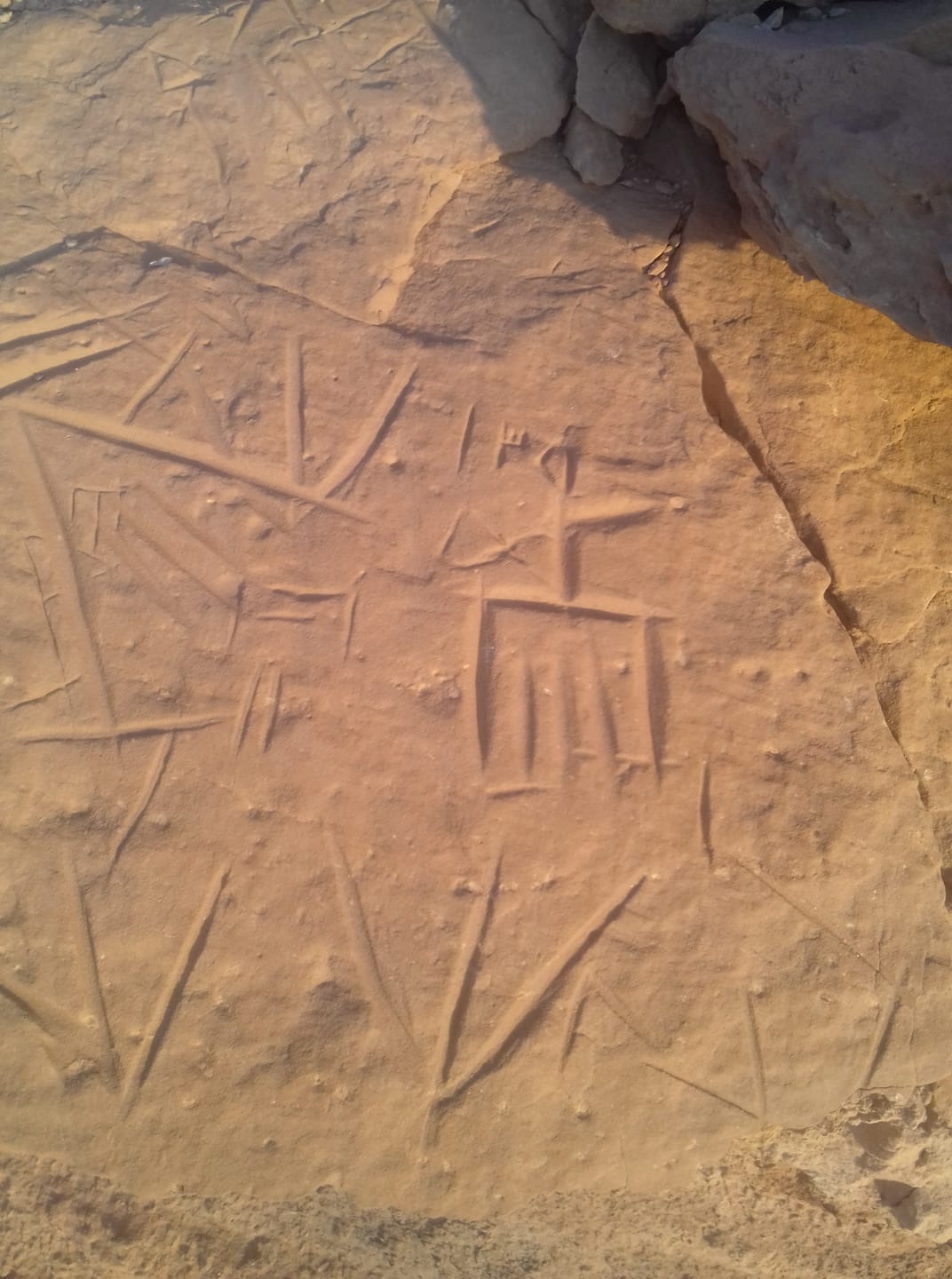
I will attempt to read the broken tablet. First of all it is hard to make out some of the signs on this piece, especially parts of line three(3) and five (5), but I will attempt to read the piece.

Reading the piece from right to left we have the
following:
Transliteration
1.
m...e-ne...ap. ...
2.
[s]....mlo.. nea...š... ..
3.
m...p....b.. .ye..... s
4.
e.....q....b. ...p...nea. ...
5. [o]...lo...
n-ne...ml... .ne...s.. .mš....
Translation
"...(1)The
great Commander and ancestor.... (2)[prop up] the inner heart at this time (of)
the King....(3) m entreat the Ba to travel (and) prop up...(4)Register the wish
(of) the Ba to solicit at this time....(5)[ Begin] to dispatch Goodness and the
good spirit (of) the son of Mash.....
Vocabulary
ap, ancestor, father
m , great
e-ne,
commander
e, register;
vouchsafe; grant a boon
b, Ba
ml, spirit
mlo,
innerheart, soul
s, son;to
protect; to prop up
ye, to make;
travel, voyage
nea, at this
time;
ne, good
n-ne, Goodness
mš, Mash
lo, dispatch
o, begin
The so called
word divider sign : equals -ne. The : is used to change verbs
into nouns, or means good.

At the lion
temple of Naqa, we find Natakamani on the left façade and Amanitore on the
right. Under the feet of the ruling pair we find friezes of their defeated
enemies.
There are a
number of Meroitic hieroglyphics on the front of the Naqa Lion Temple. There
are three columns of hieroglyphic inscriptions on under the falcon of King Natakamani.
Reading from left to right we see the following

Transliteration
1. ter tel i
ne
2. …ni-ne b-q
r
3. ikh iy kh
te b d r te
Translation
"1….the erection (of
this structure) elevates (our) tradition [of building].2…brillian ce (is) also
desired indeed.3…this spot bring Great light (and) also leave a legacy (of)
unity." We can interpret the inscriptions and engraving from this part of
the temple as follows:"King Natakamani smites the enemies of Meroe. The
royalty "...[has made] the erection (of this structure) to elevate (as is
our) tradition.2…Brillian ce (is) also indeed desired.3…This spot to bring
Great light (to many and) also leave (to the Meroites) a legacy (of)
unity."
Funerary Stela of Meteye

This Stela
dates back to the 2nd to 3rd Centuries. It is has a reddish-white undercoat. It
comes from Grave 275, Karanog. The stela is located in Cairo, Egyptian Museum
JE40229.
The couple Meteye and Abakharta stand under the inner wings of the sun
disk. Meteye wares her hair with a topknot and cornrows. This man may be either
Meteye's husband or father. (I am uncertain because the words ab-a can be interpreted as `[her] father'.
If this is the
correct reading aba
Kharta would mean
`her father Kharta'.)The grave was excavated by Woolley-Randall- MacIver at
Karanog.
The skeleton
in the grave was of a woman. The pointed breast on the figure indicate that she
was a young women. Standing side by side suggest that this man was her husband.
Since the grave contained only one skeleton we can imagine that Abakharta was
depicted on this stela to show his devotion to his wife.There are three sets of
inscription on this stela.
There are
inscriptions in front of Meteye and Abakharta, and an inscription between the
legs of Abakharta.Reading from right to left beginning with the inscription
between the legs of Abakharta, then the inscription before Abakharta and
finally the one in front of Meteye we have the following:Inscription between
Abakharta's legs.
P .. š
….o …."Pray for the patron to commence……"
Inscription
in front of the man:
Wosi ..
ne. Sore… yi-ne. Abkharta… ke ….lo …..wi-ne... a…kh…m…še.."
Translation
Isis the
Good. Osiris the eternal. Abakharta gives permission (for) the offering of this
Object of Respect (Meteye) to acquire greatness (and) protection."
Inscription
in front of the woman:
Woš..i-ne…šore..
yi-ne..Meteye… qo …wi…ato ….mh…ene… š.. o-a….tene
Translation
"Isis
the good. Osiris the eternal. Meteye , renew (her) honor down the path (to)
abundant alms giving. The patron [Meteye] has commenced the Rebirth".

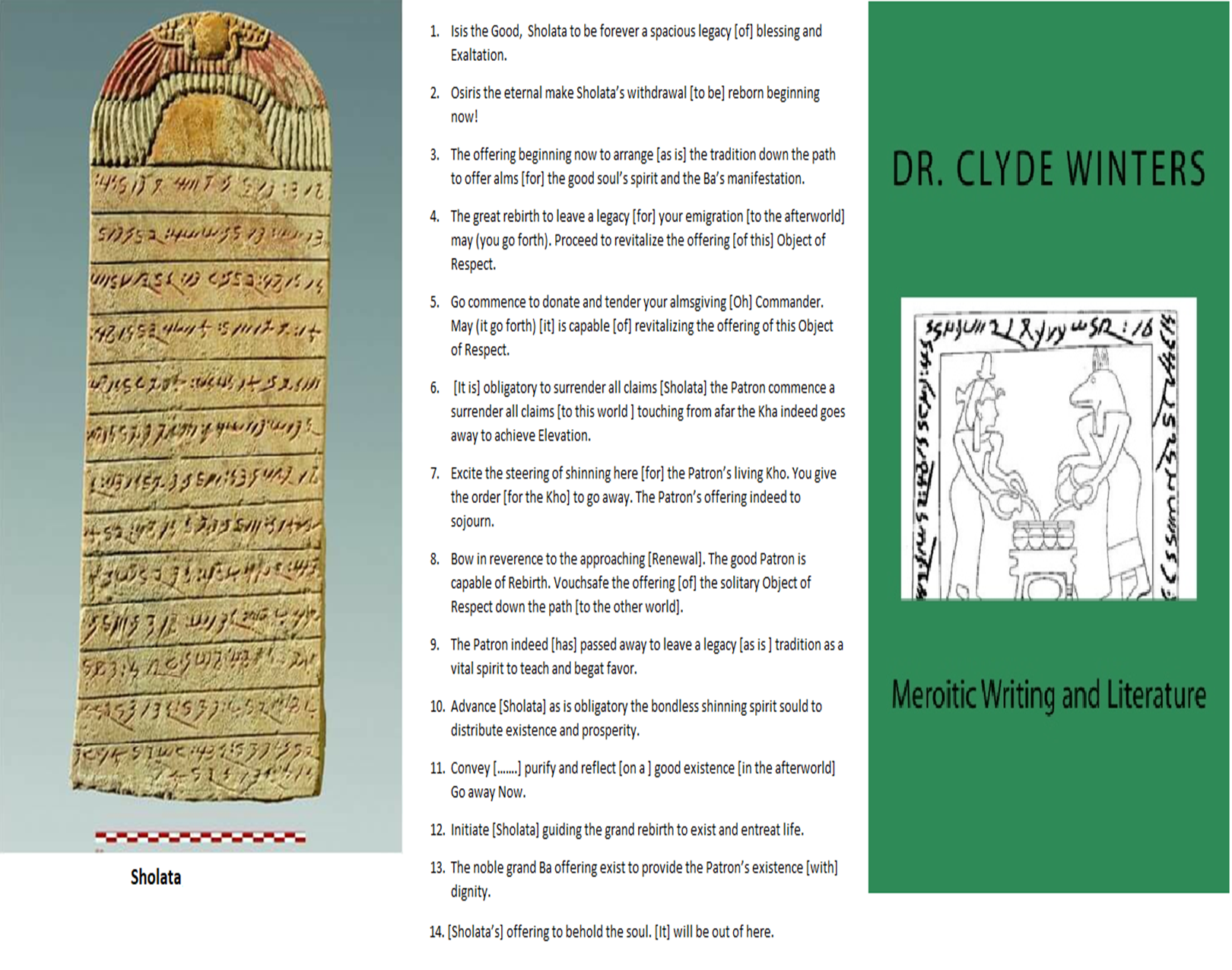
Funerary stelae of
Prince Tedeqen, circa 100-200 B.C.

Transliteration
Woš-i-ne
…Tdeqen …ne …^h …ml …. ol … ho ….lk …tene ..at …mlo …ne… p … rem … eš …. d …. o
… tl … wi-ne … el …^h …tene ….ete …. eš …. d…. ot …. el … ^h … tene …^he …. ra
…. Ke-ne-l ….l …d …tene.
Translation
[Oh] Good Isis (give)
Tedeqen kha, grand inner heart (and) soul to behold the path of rebirth. The
good inner heart prays to witness (its) manifestation. (This) bequeathal to
open (and) elevate the Object of Respect (i.e., Tedeqen) gift (of the) Kha's
rebirth (Oh Isis). You give the manifestation of the bequeathal prestige. The
gift (of) the Kha's (and the) external body's rebirth . Indeed [Tedeqen]
revitalization (will) be the rebirth of the bequeathal (of the Kha).
Offering Stela of
Tablet of Tedeqen

Inscription
under the gods:
[………] lo….
wi-ne ….šo ….tk ….te
Translation:
"Dispatch
(this) Object of Respect [Tedeqen] to live and to reflect (on good)—may (it go
forth)."
Inscription
on the funerary tablet reading from left to right and around the tablet :
Wosi …i-ne
…a…. šore ….. yi-ne ….tedeqen ….qo-ne …ah ..d …s-ne-l …. d …h … lo-ne… me …n
…tone …e ….ri-ne …..ke …. li-ne …..e … ri …ke …lo… ne … atom … lo ..ne ….el … h
…..tene ….al …ml …ol
Translation
"Isis the Good, Osiris
the eternal. Tedeqen to live good (and) to acquire a lasting legacy (of Good).
The patron's legacy (is for) the Kha's transmigration , measure the Good
Rebirth (now). Give withdrawal (to the Kha) for revitalization (and)
exaltation. Register the sendoff (of the Kha) to invigorate the good offering
(of Tedeqen). He is to be (re)born to transmit Good (as his) gift (to mankind).
The Kha's noble (re)birth (of a) grand soul."
The
most interesting Meroitic text concerning Apedemak is found on the votive
tablet of Tañyidamani which is now found in the Paris Museum.

On this votive
tablet Tañyidamani is depicted on the obverse side , and the god Apedemak on
the reverse side.On the reverse side of the Tañyidamani votive tablet the god
Apedemak is depicted wearing a short apron and hemhem crown.
On this votive
tablet Apedemak also wears armlets, bracelets, a collar and pectoral. Inside a
panel in front of Apedemak we find a cursive Meroitic inscription.The
inscriptions in the panel on the reverse side of the votive tablet of King
Tañyidamani make it clear that the king acknowledged the important role the god
Apedemak played in his life. These inscriptions can be read either from right
to left or top to bottom.
Reading from
right to left we read:
TRANSLITERATION
OF REVERSE SIDE OF VOTIVE TABLET OF KING TAÑYIDAMANI
Transliteration
1. w e to2. q
tel3. w to si4.tone m-k5. d.[l]..r-i6.te i
TRANSLATION
1. You (it
is Apedemak who) gives guidance.2. Revitalize support (for me King
Tañyidamani).3. You guide (me) to satisfaction.4. (And ) much reverence (for
your patron).5. Give (it) amicably (to me).6. May (it go forth).
Reading this
same inscription top to bottom we find the following:
TRANSLITERATION OF THE REVERSE SIDE OF THE VOTIVE TABLET
OF KING TAÑYIDAMANI
1. w q b-to
d-te.2. e te to m ne l.3. toe i skr-i.
TRANSLATION
1. (Oh
Apedemak) Guide and Make Honor (for your patron).2. Give here your (full)
measure of Good indeed. 3. (It is) thou (Apedemak who) give(s) leave to
eminence (for your patron).

Temadelo Inscription

The Temadelo funerary tablet/stela was found at Sedeinga.
This tablet was found after the demolition of a house in the village of Qubbat
Salim in 1966.
The Temadelo tablet has six lines of late Meroitic script.
1…R qo wi-ne di b…nke ne te d ḫ …
2, Te e mdele wi-ne Woš ni te š-n l-h l-ne
3. I-ne še nte l-ne š te lo wi-ne h l bi
4. [N]e..š telo wi-ne ate ḫ šo-ne pl d e
5. ne p šo ba-ne wo š tene ye tem de lo
6. ..ate lo wi-ne ato mḫ ep
Translation
1….Indeed create honor, guide its passage to the
Ba…k-Commands the donation of the Kha…2. ..Give Temadelo honor, Isis the
Shining. Place the Patron in the resting place….3….i-ne the Patron bows in
reverence (to the god) to be elevated. Honor the Khe and the Ba leaves…4.,,,ne to be elevated to
dispatch honor’s progression of the Kha [vital spirit] is of unlocking the
departure pious indeed…5..ne to beg existence in Bane, Isis the Good is capable
of unlocking the departure [to Bane]…..6….The path of the lonely Commander
(was) suitable (for) many [of our] ancestors……