Wednesday, March 27, 2024
C. Loring Brace, Noriko Seguchi, Conrad B. Quintyn, Sherry C. Fox, A. Russell Nelson, Sotiris K. Manolis, and Pan Qifeng (2005). The questionable contribution of the Neolithic and the Bronze Age to European craniofacial form.
The questionable contribution of the Neolithic and the Bronze Age to European craniofacial form C. Loring Brace, Noriko Seguchi, Conrad B. Quintyn, Sherry C. Fox, A. Russell Nelson, Sotiris K. Manolis, and Pan Qifeng
This article supports the African origin of the original Europeans.
Abstract
Sunday, April 23, 2023
It is false to claim that Egyptian haplogroups are of Eurasian origin
Recent population genetics articles indicate that many of the haplogroups we associate with Europeans and Middle Easterners were first carried by African or Negro people. This results from the fact that the first homo sapien sapiens had migrated from Africa into Europe. These Negro Civilizations in Europe were: Aurignacian, Gravettian (31-26 ka ), Solutrean ( Spain and France c23-31ka), Magdalenian (France,Germany and Poland 18-15ka), Epigravettian (17-13ka) and the Neolithic (11-5ka). Posth et al (2023) argue that the genome carried by the : Aurignacian(44-31 ka) , Gravettian (31-26 ka ), Solutrean ( Spain and France c23-31ka), Magdalenian (France,Germany and Poland 18-15ka), Epigravettian (17-13ka) and the Neolithic (11-5ka) mtDNA haplogroups U2,U4 and R1b and Y-Chromosome haplogroups Q,R, and J. The population associated with these cultures, based on craniometric measurements were Negroes/African who migrated into Europe from Africa.
Numerous Sub-Saharan skeletons found in Europe (Boule, M., HV Vallois, 1957; Barral,L. & Charles,R.P. ,1963; Caramelli,D.,Lalueza-Fox,C et al, 2003;Verneaux,R.,1926; Diop,A.1974, 1991) . The Aurignacians and the early European farmers fail to share haplogroups found among contemporary Europeans. Ancient DNA found in the ancient skeletons dating back to the Aurignacian period belong to the N haplogroup (Brace, C.L. , Noriko Seguchi, Conrad B.et al, 2006).
The archaeological and craniometric measurements show that the Solutreans were Africans, namely Bushmen or Khoisan. The Aurignacian civilization was founded by the Cro-Magnon people who originated in Africa. They took this culture to Western Europe across the Straits of Gibraltar. The Cro-Magnon people were probably Bushman/Khoi. These Europeans were Negroes.
There have been numerous "Negroid skeletons" found in Europe. Marcellin Boule and Henri Vallois, in Fossil Man, provide an entire chapter on the Africans/Negroes of Europe Anta Diop also discussed the Negroes of Europe in Civilization or Barbarism, pp.25-68. Also W.E. B. DuBois, discussed these Negroes in the The World and Africa, pp.86-89. DuBois noted that "There was once an "uninterrupted belt' of Negro culture from Central Europe to South Africa" (p.88).
The Aurignacian civilization is one of the oldest civilizations in Europe. It dates back to 46,000 years ybp (Demidenko Y.E., Otte M. & Noiret P. (2012) . This is false the earliest sites for Aurignacian are found in Spain. The radio carbon dates for Bugalria, i.e., the Kozarnika Cave, date back to 39-36kya. Earlier researchers claimed that the artifactual material found at the Bacho Kiro cave, dating to 46kya was Aurignacian, but the remains that consist of a pair of fragmented human jaws, is disputed and researchers don’t know whether these were early humans Homo sapiens or Neanderthals.
The first Aurignacians in the Levant date back to 36-34kya from Ksar Akil. The oldest Aurignacian remains come from Iberia/Spain. These sites vary in age from 41kya for the l'Arbreda Cave, and 43kya for Abric Romani, located in Catalonia, Spain.
The dates for the Aurignacian in Europe make it clear this culture spread from west to east. You can also recognize that Aurignacian appears not to have reached the Levant, until 11ky after it was established in Spain.
These dates for sites where amh were found in Western Europe make it impossible for claims of U6, M1 and etc., originating prior to 32kya in the Levant and entering Africa via a back migration 40kya.
Many researchers believe that the Aurignacian culture entered Europe from the Levant. Although this view has been accepted without challenge, the archaeological evidence indicates that AMH replaced Neanderthal during the Aurignacian period in Europe around 32-35kya (4). It is also evident that archaic humans were replaced in much of the Levant by the Levantine Aurignacian culture bearers by a local variant of the technology at Ksar Akil Xlll-Vll 32kya , not 60-50kya(4-6 ) as assumed by many researchers..
The research indicates that this view is false. The archaeological evidence makes it clear that ‘classic Aurignacian’ began in Iberia and expanded eastward across Europe ( Boule, M., HV Vallois, 1957; Barral,L. & Charles,R.P. ,1963; Caramelli,D.,Lalueza-Fox,C et al, 2003;Verneaux,R.,1926; Diop,A.1974, 1991).
The Aurignacian civilization appears to have expanded from West to East (Diop,1974). The founders of this culture came from Africa (Boule and Vallois, 1957). Some researchers have argued that the Aurignacian culture was introduced to Europe(Bordes,1972 ; Lindly et al, 1990). They based this conclusion on the fact that its tool kit was foreign to the Mousterian type, and the culture appears in a mature form throughout Europe from France to Central Europe ( Mellars, 1992,2006; and Bordes, 1972 ).
The craniofacial evidence makes it clear that the Levantines and Aurignacian population came from Africa (Boule, M., HV Vallois, 1957; Barral,L. & Charles,R.P. ,1963; Caramelli,D.,Lalueza-Fox,C et al, 2003;Verneaux,R.,1926; Diop,A.1974, 1991). As a result we find that craniofacial features of the Grimaldi-Cro-Magnon population(8) and especially the Natufian populations when plotted fall within the range of Sub-Saharan populations like the Niger-Congo speakers ( Brace,2006) .
Solutrean
Many researchers have recognized that the Solutrean culture of Iberia probably originated in Africa(Burkitt, 2012; Childe, 2001; Debenath et al.,1986; Debenath and Dibble, 1994; Tiffagom, 2007). It is the mainstream view of Spanish prehistorians that the Solutrean culture originated in Africa (Pericot,1950). Boule and Vallois (1957) noted that ancient tool kits found in South African burials along the coast are associated with the Solutrean industry.
Pericot (1950, 1955) believed that the tanged points at the Parpallo site of the Solutrean were of Aterian cultural origin. Burkitt (2012) said that there were Algerian tools similar to the Solutrean tool kit. Gordon Childe (2009) claimed that the North African and Spanish populations that used the Solutrean tools were in direct communication. By the 1960’s, though, Smith (54) was able to reject the hypothesis of an African origin for the Solutrean culture.
Boule and Vallois in , Fossil men : elements of human palaeontology, noted that "We know now that the ethnography of South African tribes presents many striking similarities with the ethnography of our populations of the Reindeer Age. Not to speak of their stone implements which, as we shall see later , exhibit great similarities, Peringuey has told us that in certain burials on the South African coast 'associated with the Aurignacian or Solutrean type industry...."(p.318-319). They add, that in relation to Bushman art " This almost uninterrupted series leads us to regard the African continent as a centre of important migrations which at certain times may have played a great part in the stocking of Southern Europe. Finally, we must not forget that the Grimaldi Negroid skeletons sho many points of resemblance with the Bushman skeletons". They bear no less a resemblance to that of the fossil Man discovered at Asslar in mid-Sahara, whose characters led us to class him with the Hottentot-Bushman group.
Posth et al (2023) explains that Gravettian Culture was a Pan-European culture that represented a “biologically homogeneous population on the basis of craniometric ( which I have illustrated prove they were Negroes/Africans) and genomomic data during the Last Glacial Maximum (LGM). Posth et al (2023) illustrates that Gravettian Culture was widespread and made up primarily of Goyet Q2 and Villabrium R1 ancestry.
Posth et al (2023) genomic data made it clear that the Blacks who belonged to the Gravettian Culture carried mtDNA haplogroups U2,U4 and R1b and Y-Chromosome haplogroups Q,R, and J (p.122). Posth et al (2032), explained that the Western hunter-gather (WHG) population belonged to Villabruna ancestry, while the Eastern hunter-gathers (EHG) ancestry was haplogroup Q.
In summary, the first modern homo sapiens came to Europe from Africa as pointed out by Boule and , DuBois and Diop make it clear the craniometric data indicated this population was Negro or African. These populations founded the Negro Civilizations in Europe that included: Aurignacian(44-31 ka) , Gravettian (31-26 ka ), Solutrean ( Spain and France c23-31ka), Magdalenian (France,Germany and Poland 18-15ka), Epigravettian (17-13ka) and the Neolithic (11-5ka).
Since thefist populations in Europe that came from Africa carried mtDNA haplogroups U2,U4 and R1b and Y-Chromosome haplogroups Q,R, and J, these haplogroups had probably first originated in Africa, instead of Europe. And as a result, mtDNA haplogroups U2,U4 and R1b and Y-Chromosome haplogroups Q,R, and J that appear in Egypt and Europe are of African, not Eurasian origin.
References:
Barral,L. & Charles,R.P. (1963) Nouvelles donnees anthropometriques et precision sue les affinities systematiques des negroides de Grimaldi, Bulletin du Musee d’anthropologie prehistorique de Monaco, No.10:123-139.
Brace, C.L. , Noriko Seguchi, Conrad B. Quintyn, Sherry C. Fox, A. Russell Nelson, Sotiris K. Manolis,** and Pan Qifeng. (2006). The questionable contribution of the Neolithic and the Bronze Age to European craniofacial form. Proc Natl Acad Sci U S A. 2006 January 3; 103(1): 242–247.
Brown, S.J. (2006). Neanderthals and modern humans in western Asia. Retrieved 2/7/2007 at: http://karmak.org/archive/2003/01/westasia.html
Boule, M., HV Vallois . (1957). Fossil Man . Dryden Press New York
Bordes, Francois.(1972 ). L’Origine de l’homme moderne.Paris, UNESCO.
Burkitt MC (2012). Prehistory: A Study of Early Cultures in Europe and the Mediterranean Basin
(Cambridge University Press).
Childe VG (2009). The Prehistory of European Society (University College, London).
Caramelli,D.,Lalueza-Fox,C., Vernesi,C., Lari,M.,Casoli,A., Mallegni,B.C., Dupanloup, I., Bertranpetit,J., Barbujani,G., Bertorelle,G. (2003). Evidence for a genetic discontinuity between Neandertals and 24,000 year-old anatomically modern Europeans. Proc Natl Acad Sci U S A., 100 (11):6593-6597.
De Domínguez EF (2005). Polimorfismos de DNA mitocondrial en poblaciones antiguas de la cuencamediterránea. PhD thesis, Departament Biologia Animal, Universitat de Barcelona.
Débenath A and Dibble H (1994). Handbook of Palaeolithic Typology, Volume 1: Lower and Middle Palaeolithic of Europe (University of Pennsylvania Press).
Débenath A, Raynal JP, Roche J, Texier JP and Ferembach D (1986). Stratigraphie, habitat,
typologie at devenir de l’Atérien Marocain: Données récentes. L’Anthropologie 90(2) 233-246.
Diop,A .(1974). The African Origin of Civilization. Lawrence Hill Books . https://www.almendron.com/tribuna/wp-content/uploads/2019/10/african-origin-of-civilization-complete.pd
Diop, Cheikh Anta. (1991 ). Civilization or Barbarism. https://www.sahistory.org.za/sites/default/files/archive-files3/cheikh_anta_diop_civilization_or_barbarism_an_abook4me
Demidenko Y.E., Otte M. & Noiret P. (2012) - Siuren i rock-shelter. From Late Middle Paleolithic and Early Upper Paleolithic to Epi-Paleolithic in Crimea. Liège, ERAUL 129, 2012, p. 343-357. http://orbi.ulg.ac.be/bitstream/2268/135222/1/Chapter%2018%20Europe%20Aurignacian.pdf
Gilead,I.(2005). The Upper Paleolithic period in the Levant. Journal of World History, 5(2): 105-154.
Haak, W. Peter Forster, Barbara Bramanti, Shuichi Matsumura, Guido Brandt, Marc Tänzer, Richard Villems, Colin Renfrew, Detlef Gronenborn,Kurt Werner Alt, Joachim Burger. (2005) Ancient DNA from the First European Farmers in 7500-Year-Old Neolithic Sites. Science 11 November 2005: Vol. 310. no. 5750, pp. 1016 – 1018.
J. M. Lindly; G. A. Clark; O. Bar-Yosef; D. Lieberman; J. Shea; Harold L. Dibble; Phillip G. Chase; Clive Gamble; Robert H. Gargett; Ken Jacobs; Paul Mellars; Anne Pike-Tay; Yuri Smirnov; Lawrence Guy Straus; C. B. Stringer; Erik Trinkaus; Randall White .(1990). Symbolism and Modern Human Origins [and Comments and Reply] Current Anthropology, 31( 3): 233-261.
Mellars, P.A. (1992).Archaeology and the Population-Dispersal Hypothesis of Modern Human Origins in Europe. The Origin of Modern Humans and the Impact of Chronometric Dating. .Philosophical Transactions: Biological Sciences, 337( 1280) : 225-234.
Mellars,P.A. (2006).Going East:New Genetic and Archaeological Perspectives on the Modern Human Colonization of Eurasia. Science 333 (11 August):796-800.
Pericot L (1950). La Espana Primitiva (Barcelona, Spain).
Pericot L (1955). Sur les connexions europeHennes de l'AteHrien, Etat actuel du proble`me. Actes du II Congre`s Panafricain de PreHhistoire (Algiers), Paris.
Posth C, Yu H, Ghalichi A, Rougier H, Crevecoeur I, Huang Y, Ringbauer H, Rohrlach AB, Nägele K, Villalba-Mouco V, Radzeviciute R, Ferraz T, Stoessel A, Tukhbatova R, Drucker DG, Lari M, Modi A, Vai S, Saupe T E, Haak W, Krause J et al.(2023). Palaeogenomics of Upper Palaeolithic to Neolithic European hunter-gatherers. Nature. 2023 Mar;615(7950):117-126. doi: 10.1038/s41586-023-05726-0. Epub 2023 Mar 1. Erratum in: Nature. 2023 Mar 22;: PMID: 36859578; PMCID: PMC9977688. https://www.nature.com/articles/s41586-023-05726-0
Steven,L.K. Stiner,M.C., Reese,D.S. & Gulec,E. (2001). Ornaments of the earliest Upper Paleolithic:New insights from the Levant. PNAS, 98(13):7641-7646.
Tiffagom M (2006). El Solutrense de facies ibérica o la cuestión de los contactos mediterráneos (Europa, África) (pp. 60-77), en el Último Máximo Glacial. In: Sanchidrián, J.L., Márquez, A.M., Fullola, J.M. (Eds.), IV Simposio de Prehistoria Cueva de Nerja. La Cuenca Mediterránea durante el Paleolítico Superior 38000-10000 años. Reunión de la VIII Comisión del Paleolítico Superior U.I.S.P. Fundación Cueva de Nerja. Nerja.
Verneaux,R.(1926). Les Origines de l’humanite. Paris: F. Riedder & Cie.
Winters C (2008). Aurignacian Culture: Evidence of Western Exit for Anatomically Modern Humans. South Asian Anthropologist 8 79-81.
Winters C (2010). The African Origin of mtDNA Haplogroup M1. Current Research Journal of
Biological Sciences 2(6) 380-389, Available: https://www.academia.edu/3036833/The_African_Origin_of_mtDNA_Haplogroup_M1
Winters C (2011). The Gibraltar out of Africa Exit for Anatomically Modern Humans. WebmedCentral BIOLOGY 2, Available: http://www.webmedcentral.com/article_view/2311
Winters C (2014a). Were the First Europeans Pale or Dark Skinned? Advances in Anthropology 4 124-132, Available: http://dx.doi.org/10.4236/aa.2014.43016
Winters C (2014b). African and Dravidian origins of the Melanesians. Indian Journal of Fundamental and Applied Life Sciences 4(3) 694-704, Available: http://www.cibtech.org/J-LIFESCIENCES/PUBLICATIONS/2014/Vol-4-No-3/JLS-103-JLS-073-JUN-CLYDE-AFRICANMELANESIANS.pdf
Winters C (2015a). African origins of Paleoamerican DNA. CIBTech Journal of Microbiology 4(1) 13-18, Available: http://www.cibtech.org/J-Microbiology/PUBLICATIONS/2015/Vol-4-No-1/03-CJM-004-CLYDE-AFRICAN-DNA.pdf
Winters C (2015b). Inference of Ancient Black Mexican Tribes and DNA. WebmedCentral GENETICS 6(3), Available: http://www.webmedcentral.com/article_view/4856
Tuesday, January 25, 2022
R1 haplogroup an ancestral genetic signature of East Asia
In addition to craniometric evidence we also have genetic evidence for the African origin of the Chinese.
The genotype data provides clear evidence of the phylogenetic relationship of Africans and East Asians. It is clear that African derived haplogroups R1b1, E, DE and R1b1b2 are found in East Asia. Y-haplogroup is found among many Chinese Muslims or Huis.
There is evidence of R1 in East Asia. Zhong et al (2011) reported a number of y-chromosome markers in East Asia including R1a1 (29.41%0, R1b* (3.2%), R1b1b2 (1.6%) and R2 (3.21%).
It is interesting to note that Zong et al (2011) tested for the M335 marker which was first discovered in Turkey and classified as R1b. The M335 marker is a brother clade to R1b1* (M343+V88-M73-M269). This is interesting because R1b1* pursuant to ISOGG is R1b1 or V88.
Reference:
Zhong H, Shi H, Qi XB, Duan ZY, Tan PP, Jin L, Su B, Ma RZ. Extended Y chromosome investigation suggests postglacial migrations of modern humans into East Asia via the northern route. Mol Biol Evol. 2011 Jan;28(1):717-27. doi: 10.1093/molbev/msq247. Epub 2010 Sep 13. PMID: 20837606.
Saturday, January 22, 2022
Anzick and Luzia People are related
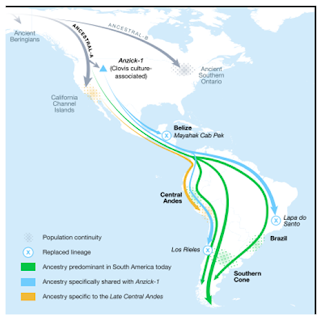
Posth et al (2017) in their genetic study noted that “ Genome-wide analysis of 49 Central and South
Americans up to 11,000 years old d Two
previously unknown genetic exchanges between North and South America d Distinct
link between a Clovis culture-associated genome and the oldest South Americans
d Continent-wide replacement of Clovis-associated ancestry beginning at least
9,000 years ago “.
Some researchers have used this article to claim that the
Paleoamericans, the most ancient Native Americans are related to contemporary mongoloid
Indians. This view is false. Posth et al, in their study supported the view
that Anzick child and Luzia culture folk were related.
Posth et al (2018), did not make this finding. The
researchers reported that “The oldest individuals in the dataset show
little specific allele sharing with present-day people. For
example, a ∼10,900 BP individual
from Chile (from the site of Los Rieles) shows only slight excess affinity to
later Southern Cone individuals. In Belize, individuals from two sites
dating to ∼9,300 and ∼7,400 BP (Mayahak Cab Pek and Saki Tzul) do
not share significantly more alleles with present-day people from the region
near Belize than they do with present-day groups elsewhere in Central and South
America. In Brazil, genetic data from sites dating to ∼9,600 BP (Lapa do Santo) and ∼6,700 BP (Laranjal) show no distinctive shared
ancestry with present-day Brazilians (Figures 2 and S1; Table S1)”.. The authors added, “The distribution of this
statistic f4(Mbuti, Test; USR1, Anzick-1)
confirms previous findings that Anzick-1 relatedness is
greatest in Central and South Americans and lowest in North American groups” noted
that “(Posth et al, 2018).
As a result, there was no continuity between
Paleoamericans and modern Native Americans. Posth et al (2018) noted that “ However, the fact that the
great majority of ancestry of later South Americans lacks specific affinity to Anzick-1 rules out the hypothesis of a homogeneous founding
population”.
Paleoamericans are related to Australians, Africans or
Melanesian, in other words a cranial morphology of the Negro/Black people.
This view was supported by the Posth et al (2018) who noted
that ” Our finding of no excess
allele sharing with non-Native American populations in the ancient samples is
also striking as many of these individuals—including those at Lapa do
Santo—have a “Paleoamerican” cranial morphology that has been suggested to be
evidence of the spread of a substructured population of at least two different
Native American source populations from Asia to the Americas”.
Although, some researchers claim that the Paleoamericans
came from Asia, this finding is not supported by the genetic evidence that make
it clear that the oldest inhabtants of East Asia are not related to the
Paleoamericans. Posth et al (2018) wrote “Our failure to find significant
evidence of Australasian or Paleolithic East Asian affinities in any
of the ancient Central and South American individuals raises
the question of what ancient populations could have contributed the Population
Y signal in Surui and other Amazonian groups and
increases the previously small chance that this signal—despite the strong
statistical evidence for it—was a false-positive.”.
References:
Posth C, Nakatsuka N, Lazaridi I, et al. (2018) Reconstructing
the Deep Population History of Central and South America. https://www.cell.com/action/showPdf?pii=S0092-8674%2818%2931380-1
Anzick DNA
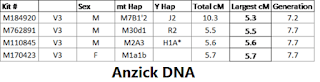
Researchers often compare aDNA to modern groups. When DNAeXplained – Genetic Genealogy compared Anzick boy DNA to modern groups they found it was related to Y-hap R2. (https://dna-explained.com/2015/01/05/anzick-matching-update/ ) the current Anzick kit, F999919, and found at 5cM and below that there were 4 haplogroup M matches.
Note:
Haplogroup R2, or R-M479, is a Y-chromosome haplogroup
characterized by genetic marker M479. It is one of two primary descendants of
Haplogroup R (R-M207), the other being R1 (R-M173).
R-M479 has been concentrated geographically in South Asia
and Central Asia since prehistory. It appears to reach its highest levels among
the Burusho people in North Pakistan.[2] However, it also appears to be present
at low levels in the Caucasus, Iran, Anatolia and Europe.[citation needed]
It has two primary branches: R2a (M124) and R2b (R-FGC21706).
Originally Chatters thought they were Europeans, since his
research into Naia he has come around. 12kya the paleoamericans carried the D
haplogroup, which in reality is really an M haplogroup, namely M1. This is
obvious when we look at the extract profile of Anzick man.
- Anzick
Provisional Extract, Es Haplogroup M
M – discovered in prehistoric sites, China Lake, British Columbia – 2007 Malhi, Anzick Provisional Extract, Estes, September 2014, kits F999912 and F999913
M1a – Anzick Provisional Extract, Estes, September 2014, kits F999912 and F999913
M1a1b – Anzick Provisional Extract, Estes January 2015 – (1 M1a1b
M1a1e – USA – Olivieri, many Eurasian in Genbank
M1b1 – Anzick Pr ovisional Extract, Estes, September 2014, kits F999912 and F999913
M2a3 – Anzick Provisional Extract, Estes January 2015 – (1 M2a3)
M23 – Anzick Provisional Extract, Estes, September 2014, kits F999912 and F999913, Madagascar – Recaut and Debut, Madagascar Motif
M3 – Anzick Provisional Extract, Estes, September 2014, kits F999912 and F999913
M30c – Anzick Provisional Extract, Estes, September 2014, kits F999912 and F999913
M30d1 – Anzick Provisional Extract, Estes January 2015 – (1 M30d1)
M51 – Anzick Provisional Extract, Estes, September 2014, kits F999912 and F999913
M5b3e – Anzick Provisional Extract, Estes, September 2014, kits F999912 and F999913
M7b1’2 – Anzick Provisional Extract, Estes, September 2014, kits F999912 and F999913, Anzick Provisional Extract, Estes January 2015 – (1 M7b1’2)
M9a3a – Anzick Provisional Extract, Estes, September 2014, kits F999912 and F999913tes January 2015 – (7 D with no subgroup
Haplogroup D and M1 are just about the same as shown by the Anzick extractions. See: http://dna-explained.com/2013/09/18/native-american-mitochondrial-haplogroups/
As laymen we assume that when geneticist extract DNA, they automatically
determinw what haplogroup the ancient skeleton carried, but as you can see from
these provisional extractions the results are varied.
A few years ago I made a blanket statement in an article that there were no M
haplogroups in America. One of the peer reviewers commented that there were M
haplogroups in the Americas, and this statement was false. I had not found any
literature on M groups in the Americas , so I was surprised to hear this. Some
propagandists are upset about the provisional Anzick data because it supports
the discovery of M at China Lake in Canada. Claiming the Native Americans
belong to the D clade, is just a way of denying the presence of haplogroup M in
the Americas.
Archaeologist do not like to talk about the fact that M clades were carried by
Native Americans, because then you are able to link the paleoamericans and
later groups to Africa.
See: http://dna-explained.com/2015/01/05/anzick-matching-update/
The paleoamericans, c. 25-10kya were Khoisan. The Khoisan introduced the
Solutrean culture into the Americas and Europe. The discovery of M haplogroups
in the Americas is further support for my theory that the Khoisan spread
L3(M,N) into Europe. See:
http://maxwellsci.com/print/crjbs/v2-380-389.pdf
http://bioresonline.org/archives/A130.pdf
Looking at the Anzick extractions can show you how geneticist make the decision
on what group a population belongs too based on their own ideology.
.
Tuesday, November 16, 2021
Munda cultures in India and Iran share features
Shinde and Narasimhan et
al.: "An Ancient Harappan Genome Lacks Ancestry from Steppe Pastoralists
or Iranian Farmers" https://www.cell.com/cell/fulltext/S0092-8674(19)30967-5
The Shinde and Narasimhan study is
interesting because it maintains that based on human remains from Rakhigarhi
support the view that the largest contributor to
the ancestry among South Asians is Iranian ancestry. “But this new study shows
that the lineage of Iranian-related ancestry in modern South Asians split from
ancient Iranian farmers, herders, and hunter-gatherers before they separated
from each other--that is, even before the invention of farming in the Fertile
Crescent”.
This
finding indicates that farming did not spread into South India from the Middle
East. "Ancestry like that in the IVC individuals is the primary ancestry
source in South Asia today," says Reich. "This finding ties people in
South Asia today directly to the Indus Valley Civilization."
This statement is false, because Rakhigarhi
was not an Indus Valley Civilization. This was a Munda civilization, the IVC
was founded by Dravidian speakers from the Nile Valley.
It is
not surprising that Southeast Asian hunterer-gatherers matched DNA from Iran
and Turkmenistan because the Munda people or negrito people like the Annamese. The
“little negroes”, like the Anu people
had spread from Africa into Eurasia after 10,000BC.
The Mehrgarh and Rakhigarhi cultures are different from the
IVC civilization. These sites are in blue on the map. These cultures like the cemetery are near the Ghaggar -Hakra
River. These sites are pre-IVC the date back to 6000BC, 3500 years older than
the IVC sites. As a result, artifacts from the Mehrgarh (7000 BC), Bhirra (7500BC),
and Rakhigarhi (6000BC ) sites that are as
much as 3500 years older than sites and the artifacts from the IVC.
Archaeological and
linguistic evidence indicates that the Dravidians were the founders of the
Harappan culture which extended from the Indus Valley through northeastern
Afghanistan, on into Turkestan. The Harappan civilization existed from
2600-1700 B.C. The Harappan civilization was twice the size the Old Kingdom of
Egypt. In addition to trade relations with Mesopotamia and Iran, the Harappan
city states also had active trade relations with the Central Asian peoples.
Fairservis makes it clear that early cultures of
Baluchistan are analogous to Early Dynastic Sumerian, this movement eastward of
the ancient Kushites led to the rise of the Indus cultures.The Sumerians, Mande
and Dravidians formerly belonged to the Maa Culture
The Dravidians in the
IVC made different figurines and made seals. The Dravidians in the IVC mainly
cultivated millet--not wheat.
The Sumerians probably called the Indus Valley Dilmun. Dilmun was a rich trade center that provided Sumer with many valuable trade items.
The Gondi were originally Munda speakers. The Gond community is widespread because the ancestors of the people living in 8 states recognized that IVC culture was superior to the original semi-farming culture the Gondi had practiced since the Mehrgarh and Rakhigarhi cultures. The Tamil introduced to the Gondi an agro-pastoral culture and literacy. The Munda speakers today refused to abandon their original culture and adopt the new cultural elements introduced to the Indus Valley by the Tamil. The art from Mehrgarh and IVC show the connection between these people.
Mehgarh was a culture developed by the Munda people web page
.In the sub-continent of India, there were several main groups. The earliest
inhabitants of India were the Veddoid people, followed by the Negritos, Mongoloid,
the Kushite-Dravidians and finally Aryan speakers.
The Negritos or Munda , Mongoloid and Africoid/
Mediterranean skeletal remains were all found at Harappan sites. The Munda or
Australoid people are a mixed group that combines the classical Mongoloid and
pygmy features. The speech of this Negrito group is believed to be Austric, a
specimen of this language survives in the Munda speech. The
Africoid/Mediterranean group is associated with Dravidian culture.
The Negritos founded the earliest culture in the Indus at
Mehrgarh and Rakhigarhi in 6000 B.C. They had domesticated goats and sheep and
grew cereals, namely wheat. Find out more about munda in the following article: http://ispub.com/IJBA/4/2/5591