Tuesday, June 9, 2020

We need a True History of the Nile Valley not just a History of Ancient Egypt


No one can deny that ancient Egypt was the greatest Civilization of Africa and that it led to the rise of Western Eurasia.
But we need to teach the world the role Nile Valley Kushites played in World History.
Europeans want to maintain the view that Kush was always ruled by Egypt and that Egypt was non-Black civilization. This is a false perspective. Both the Kushite and Egyptian civilizations were Black.

We must move away from this Eurocentric view of history, and look at Nile Valley Kushite history as an independent history from the history of Egypt..We are beginning to see now that Kushites were not just called Nehesy,they also called ḫ3s.t(j) beginning in Narmer’s time into the Old Kingdom, and k3š in Middle Egyptian beginning with the 18thDynasty.

The new history of the Nile Valley Kushites from Nubia up to Lower Egypt , must acknowledge that the Kushites spread civilization into Eurasia. It is a history that acknowledges Egypt as a great Black Civilization--but maintains that Egypt was mainly concerned with Egypt.

KemtUr S. Elagip has set the standard that all research and history regarding African people must meet " without discrimination and exclusion. ". To me this idea that one people or tribe can make history in isolation, is false . 

The great African empires Egypt, Kerma, Meroe, Mali, Songhay, had leaders who may have come from a partucular tribe, formed Federations or Confederations made up of varied tribes seeking One goal rising up the nation and the people of the Confederation. Ancient Black civilizations were founded on the idea of inclusion To these wise men there was no single religion or tribe better than any other tribe.. Truely, the history of the greatest Blacks civilizations were based on "WE"--not "I".

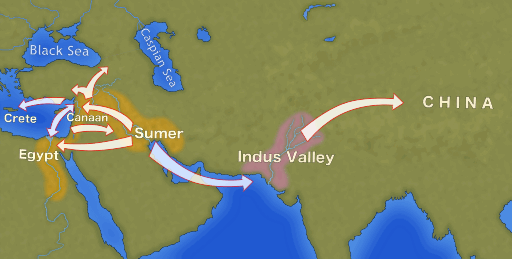
In summary Kushites possessed a worldview, which led them to explore much of Africa and Eurasia.This history will show that the civilizations of Sumer and India were also founded by Kushites from the Nile Valley. The Sumerians acknowledge their Kushite origins when they declared their kings were the kings of Kish; while in India the ancient Purana and Pali literature identifies the Nile Valley as the origin of Indian Civilization. The Puranas of India claim Kushites ruled the world for 7000 years.

Monday, June 8, 2020

Buddha came from Nubia


Buddhism originated in the Nile Valley. Anta Diop in The African Origin of Civilization . wrote that “It would seem that Buddha was an Egyptian priest, chased from Memphis by the persecution of Cambyses. This tradition would justify the portrayal of Buddha with woolly hair. Historical documents do not invalidate this tradition…There is general agreement today on placing in the sixth century not only Buddha but the whole religious and philosophical movement in Asia with Confucius in China, Zoroaster in Iran. This would confirm the hypothesis of a dispersion of Egyptian priests at that time spreading their doctrine in Asia. (p.287)”

The ancient literature of India written in the Epic Purana and Pali text support  Diop’s view that Buddhism originated in Africa. Dr. Liny Srinivasan in her books Desi (2011) and  Crete to Egypt: Missing Links of the Rigveda (2013) explains that the priests of the Epic Purana and Rigveda came from the Nile Valley and Levant; and the history mentioned in these text is about these regions not India.


Dr Liny explains (2011,2013) that much of Pali and Epic Purana literature is about the Nile Valley, especially Kush called Kaši (Kashi) and  Lower Egypt during and after  the fall of the Hyksos Dynasty . She maintains that after the fall of the Hyksos in Lower Egypt there was a dispersal of Kushite priest and mercenaries into the Levant and Anatolia.


The Egyptians called Lower Egypt: Tameh. The people of Tameh were called  ḫЗst .  This name for the people of Lower Egypt, the Levant and Nubia goes back to Narmer times. The Kushites were called ḫЗst in Africa and the Levant. Kushites had early settled in the Levant since Narmer times. We find  Narmer's name  on jars and  serekhs from excavations in Israel and Palestine , for example Tel Erani, Arad, 'En Besor, Halif Terrace/Nahal Tillah and more . A bulla dating to this period makes it clear that this part of the Negev was called ḫЗts.t ("Kush") or ḫ3s.tj ("Kushite").

The Egyptian term for Kushites ḫЗst  agrees with Kaši (Kashi) the Pali and Purana text name for Nubia. After the Old Kingdom of Egypt, the Nubian Kushites were usually referred to as Nehesy. During the New Kingdom the Kushites in Lower Egypt were called ḫЗst . and the Nubian Kushites were called K3š .

 In relation to Buddhism Dr. Liny (2013) explained that the Pali text, makes it clear that the original Budhha, Bodhisatta was born a prince of Kaši (Kashi) or a viceroy of Kaši (Kashi) (p.379). This Buddha was called Chanda,Chendak or Chenda-Kumara in the land of Gold, i.e., Egyptian Nub.

Gautama Buddha was also a Kushite. He was born in the city of Kapilavastu. Dr. Srinivasan (2013) says that Kapilavastu, is the Kushite city of Byblos or Egyptian Kpn (p.45). Gautama Buddha was born c.  563 and died in 483 BC. He was a member the Saka, tribe which Dr. Srinivasan claims originated in Nubia. He was a Kushite priest that preached in Kapilvastu or Byblos.


Indian literature establishes the Buddha in
Kaši (Kashi) Nub, and Heliopolis. The Pali literature claims he was born in Saka. The Egyptian coffin text, according to Dr. Srinivasan (2013) is mentioned in the Egyptian coffin text to a riparian land called the “Land of Sk”.   Dr. Srinivasan explains that the ‘Land of Sk’, is associated with the “House of the Red Crown”—the royalties of the Lower Egyptian Kingdom” in the Delta. Chanda Buddha was a priest at Heliopolis and Memphis before he was forced out of Egypt.


Beja tribal people were called Blemmyes in ancient times.     Blemmyes may have played an important role in Buddhist because Blemmyae, a prominent group in the Meroitic Sudan are mentioned in Pali text Tipitaka .     

Some Meroites  played an important role in Buddhist because Blemmyae, a prominent group in the Meroitic Sudan are mentioned in Pali text Tipitaka (see:JDM Derrett, (2002) A Blemmya in India, Numen 49:460-474). Dr.Derrett wrote that in early Pali text " we have a Blemmya (an African) in front rank Buddhist texts of very respectable age (p.465).

The Buddhist text where Blemmya were mentioned are very old. The Vinaya pitaka, is dated to the 4th century B.C.E.

If Blemmya are mentioned in Buddhists text we can be sure that Meroites were not ignorant of Kharosthi. This would explain why many of the Meroitic symbols agree with Kharosthi. They agree because some Meroites were probably already literate in Kharosthi due to the influence of Buddhism in the Meroitic Empire.


The Egyptian historical literature makes it clear that Buddhism was practiced by Nile valley populations in Lower Egypt, and Nubia. Memphis was a center of Buddhist worship. This makes Diop's mention of Memphis  quite interesting because it is here that Petrie (1908) found evidence of Buddhist colonist in Egypt.

 Petrie claimed the iconography date d back to the Persian period of Egyptian rule (c 525-405BC). he wrote:"on the right side, at the top is the Tibetan Mongolian, below that the Aryan woman of the Punjab, and at the base a seated figure in Indian attitude with the scarf over the left shoulder. These are the first remains of Indians known on the Mediterranean. Hitherto there have been no material evidences for that connection which is stated to have existed, both by embassies from Egypt and Syria to India, and by the great Buddist mission sent by Asoka as far west as Greece and Cyrene. We seem now to have touched the Indian colony in Memphis, and we may hope for more light on that connection which seems to have been so momentous for Western thought" (p.129).


If Petrie's  dating is correct this puts Buddhists in Egypt two hundred years before Asoka, sent Buddhist missionaries to Egypt.The Classical writers report on Indian sages in the region. This makes it clear that Buddhist had probably been living in Meroitic Empire and Egypt for 600 years before the Meroites invented Meroitic writing.
.
In summary Buddha came from Nile Valley . It was the Nehesy and Heqa ḫЗst people from the Nile Valley, including the Blemmya that were the foundation of Buddhist doctrine.

Reference:

Anta Diop. (1975). The African Origin of Civilization .

W. M. Flinders Petrie,(1908)  The peoples of the Persian Empire, Man (1908) No.71:pp.129-130.

J.D.M. Derrett, (2002) A Blemmya in India, Numen 49:460-474
.
, Thomas E Levy,David Alon,Yorke M. RowanYorke M. Rowan.(1997). Egyptian-Canaanite Interaction at Nahal Tillah, Israel (ca. 4500-3000 B. C. E.): An Interim Report on the 1994-1995 Excavations. Available from 6/8/2020; https://www.researchgate.net/publication/302287010_Egyptian-Canaanite_Interaction_at_Nahal_Tillah_Israel_ca_4500-3000_B_C_E_An_Interim_Report_on_the_1994-1995_Excavations/figures?lo=1

.Liny Srinivasan (2011). Desi

 Liny Srinivasan . (2013)  Crete to Egypt: Missing Links of the Rigveda .

Saturday, June 6, 2020

The Tehenu and Tamahu


The original inhabitants of the Sahara where the Kemetic civilization originated were Blacks not Berbers or Indo-European speakers Winters,1994). These Blacks formerly lived in the highland regions of the Fezzan and Hoggar until after 4000 BC. This ancient homeland of the Dravidians, Egyptians, Sumerians, Niger-Kordofanian-Mande and Elamite speakers is called the Fertile African Crescent. ( Anselin, 1989, p.16; Winters, 1983,1985,1991). 


We call these people the Proto-Saharans (Winters 1985,1991). The generic term for this group is Kushite. This explains the analogy between the Bafsudraalam languages outlined briefly above (Winters, 1994). These Proto-Saharans were called Ta-Seti and Tehenu by the Egyptians. Farid (1985,p.82) noted that "We can notice that the beginning of the Neolithic stage in Egypt on the edge of the Western Desert corresponds with the expansion of the Saharan Neolithic culture and the growth of its population".

The inhabitants of the Fezzan were round headed Africans. (Jelinek, 1985,p.273) The cultural characteristics of the Fezzanese were analogous to C-Group culture items and the people of Ta-Seti . The C-Group people occupied the Sudan and Fezzan regions between 3700-1300 BC (Jelinek 1985).

The inhabitants of Libya were called Tmhw (Temehus). The Temehus were organized into two groups the Thnw (Tehenu) in the North and the Nhsj (Nehesy) in the South. (Diop 1986). The Nehesy represented as the singular Kushite or African type. As a result, in most translations of Egyptian text by Egyptologists Nehesy, was translated as Negro. They did this to imply that the Egyptians were non-Black, and only the Nehesy were Blacks in the Nile Valley.

A Tehenu personage is depicted on Amratian period pottery (Farid 1985 ,p. 84). The Tehenu wore pointed beard, phallic sheath and feathers on their head.

The Temehus are called the C-Group people by archaeologists (Jelinek, 1985; Quellec, 1985). The central Fezzan was a center of C-Group settlement. Quellec (1985, p.373) discussed in detail the presence of C-Group culture traits in the Central Fezzan along with their cattle during the middle of the Third millennium BC. The Tehenu and Tamehus are depicted on Rameses III Table of Nations.
The Temehus or C-Group people began to settle Kush around 2200 BC. The kings of Kush had their capital at Kerma, in Dongola and a sedentary center on Sai Island. The majority of the Tamehu did not migrate into Kerma, they remained in the Fezzan and other parts of Libya. The same pottery found at Kerma is also present in Libya especially the Fezzan.

The Temehus/ Tehenu were agro-pastoral population that lived both in villages and dmi'w 'towns'. The Tehenu lived in the Delta between the Temehu and the Egyptians. The Egyptians referred to all of the people in this area most often by the generic tern "Tehenu”.
Oric Bates, in the The Eastern Libyans (1914), wrote the following


As you can see from the quote from Bates the Temehu were recognized as an African population.

The Tjemhu/Temehu which included the controled an area from Cyrenaica to Syria. As a result, in textual material from the reign of Ramses II, there is mention of Temehu towns in Syria. David O'Connor makes it clear that Ramses III referred to these Temehu by the term Tehenu/ Tjehnyu (p.64).


The use of different names to describe the Tehenu and Asian in the Ramses III Table of Nations is understood in relation to the political and ethnic conditions in Egypt and Western Asia during this period. The research appears to indicate that the physiognomy of the Libyans had changed by this time. This resulted , for the most part from the invasion of Egypt by Sea Peoples in association with the Libu (Libyans).


The members of the coalition that attacked Egypt were led by Meshesher the wr 'ruler' of the coalition. Each group was led by a "great one" or a magnate. The Meshwesh were semi-nomads that lived both in villages and dmi'w 'towns'. The Tehenu lived in the Delta between the Temehu and the Egyptians. The Egyptians referred to all of the people in this area most often by the generic tern "Tehenu".


The Meshwesh were very hostile to the Tehenu/Tjehnya. In fact, the first mention of the Meshwesh in Ramses III inscriptions relating to 1188, was the attack on the Tehenu, by the Meshwqesh, Soped and Sea People .


David O'Connor makes it clear that the the records of Ramses III make it clear that the Meshweshy "savagely" attacked the Tehenu and looted their cities during their advance to Egypt (p.35 & 105).

The coalition of the Meshweshy had each unit of the army organized into "family or tribal ' units under the leadership of a "great one". As result to understand why the Asian and Tehenu figures on the Table of Nations are identified differently you have use both the pictorical and textual material from the reign of Ramses III to understand the representations.

As a result, Palestianian -Syrian personage or figure D, is labled Tehenu because he was probably a member of one the Meshwesh units that fought the Egyptians, thus he was labled Tehenu ( David O'Connor (1990).


The Meshwesh are different from the Tehenu and the original Tamehu recorded by the Egyptians prior to the New Kingdom. Below we see the traditional depiction of a Tamehu, the sidelock, shoulder cape and clean face note absence of feathers in the hair.

The Meshwesh wore Tehenu traditional costumes but they are not believed to be real Tehenu. The Tehenu and the Temehu usually wore different costumes. In the New Kingdom depictions of the Temehu, the Meshwesh have "long chin beards", like the Syrian-Palestinians and Peoples of the Sea. They wear kilts, sheaths and capes open at the front tied at one shoulder. Like the earlierTehenu they wore feathers as a sign of High Status.

David O'Connor makes it clear that there was "marked hetergeneity of the Tjemhu" (p.41). The first attack by Libyans on Egypt were led by the Libu during the 5th year of Ramses III's reign. Diop has provided convincing evidence that the Libu, later migrated into Senegal, where they presently live near Cape Verde.

The difference in dress among the Meshwesh and Tehenu, and their hostility toward the Tehenu, have led many researchers to see the Temehu of the New Kingdom as a different group from the original Temehu of Egyptian traditions. O'Connor (p.74) in the work cited above makes it clear that the Temehu in Ramses III day--"[have] hairstyles, dress and apparently ethnic type [that] are markedly different from the Tjehnyu/tjemhu of the Old Kingdom (Osing, 1980,1018-19).


Various explanations have been offered: Wainwright, for example, concluded that 'Meshwesh was a mixed tribe of Libu like tribesmen with their native chiefs who become subject to a family of Tjehnu origin'(1962,p.92), while Osing suggested that the New Kingdowm Tjemhu had displaced or absorbed the earlier Tjehnyu but had selectively taken over or retained some Tjehnyu traits, in the case of the rulers for Meshwesh (1980,1019-1020). Dr. O'Connor is of the opinion "that some rulers of the later New Kingdom Tjemhu deliberately adopted traits they discovered from the Egyptians to be characteristic of ancient Tjehnyu/ Tjemhu, so as to increase there prestige, or in some way had these rtraits imposed upon them by the Egyptians" (p.74).

It is my opinion that given the organiztion of the Libyans into mhwt "family or tribal groups', sometime prior to 1230 BC over an extended period of time Indo-European speaking people later to be known as Peoples of the Sea entered Western Asia and Libya and were adopted by Tehenu families. This adoption of the new immigrants by Tehenu/Tamehu probably led to the Meshwesh and Soped adopting Tehenu customs but maintaining their traditional beards,. The original Temehu, like the Libu probably saw the integration of Sea Peoples into Temehu society as a way to increase their number and possibily conquer Egypt.

The C-Group or Temehus also founded the Kerma dynasty of Kush. Diop (1986, p.72) noted that the "earliest substratum of the Libyan population was a black population from the south Sahara". Kerma was first inhabited in the 4th millennium BC (Bonnet 1986). By the 2nd millennium BC Kushites at Kerma were already worshippers of Amon/Amun and they used a distinctive black-and-red ware (Bonnet 1986; Winters 1985b,1991). Amon, later became a major god of the Egyptians during the 18th Dynasty.

References:
Anselin,A.(1984). "Zeus, Ethiopien Minos Tamoul", Carbet Revue Martinique de Sciences Humaines,no. 2:31-50
Bonnet,C. (1986). Kerma: Territoire et Metropole. Cairo: Instut Francais D'Archeologie Orientale du Caire
Diop, A.(1987). Precolonial Black Africa. (trans. ) by Harold Salemson, Westport: Lawrence Hill & Company
Jelinek,J. (1985). "Tillizahren,the Key Site of the Fezzanese Rock Art". Anthropologie (Brno),23(3):223-275.
O'Connor,D. (1990) "The nature of Tjemhu (Libyan) society in later New Kingdom; in Libya and Egypt c1300-750 BC”. (Ed.) by Athony Leahy (pp.29-113), SOAS Centre of Near and Middle Eastern Studies and the Society for Libyan Studies, 1990.
Quellec,J-L le. (1985). "Les Gravures Rupestres Du Fezzan (Libye)". L'Anthropologie, 89 (3):365-383.
Winters, C.A. (1983). "The Ancient Manding Script". In Blacks in Science:Ancient and Modern. (ed.) by Ivan van Sertima, (New Brunswick: Transaction Books) pp.208-215.
__________. (1985). "The Proto-Culture of the Dravidians, Manding and Sumerians". Tamil Civilization,3(1):1-9.
___________. (1991). "The Proto-Sahara". The Dravidian Encyclopaedia, (Trivandrum: International School of Dravidia). Linguistics) pp.553-556. Volume l.
__________.(1994) Afrocentrism: A Valid Frame of Reference. Journal of Black Studies, December 1, 1994, pp.170-90.


Was Narmer a Kushite


There is epigraphic evidence that indicates that Narmer was probably a Kushite. Narmer ruled an area extending from the Nile Valley into the Levant.

The Levant had early been settled by people from the Nile Valley. Beginning as early as 5000 years ago Kushites the ḫЗšt, lived from the Nile Valley below Egypt, all the way to the Levant and Anatolia. The Kushites belonged to the C-Group culture of Nubia. The Kushites spoke Niger-Congo and Dravidian languages (1) . The Niger-Congo (NC) Superfamily of languages is the largest family of languages spoken in Africa. Researchers have assumed that the NC speakers originated in West Africa in the Inland Niger Delta. The research indicates that the NC speakers originated in the Saharan Highlands 12kya and belonged to the Ounanian culture (1).

The Ounanian culture is associated with sites in central Egypt, Algeria, Mali, Mauretania and Niger (1). The Ounanian tradition is associated with the Niger-Congo phyla (1). This would explain the close relationship between the Niger-Congo and Nilo-Saharan languages.

In the Eastern Sahara many individual types of tanged and shouldered arrowheads occur on early Holocene prehistoric sites along with Green Saharan/Wavy-line pottery (2-3) . 'Saharo-Sudanese Neolithic' wavy-line, dotted wavy line and walking-comb pottery was used from Lake Turkana to Nabta Playa, in Tibesti , Mauritania, on into in the Hoggar, in Niger. This pottery evolved into the Beaker Bell ceramics of Europe.

The Kushites from the Levant and Anatolia took cattle domestication and millet cultivation to Europe. There is no archaeological evidence of the herding of Cattle and millet cultivation older than the Nabta Playa material (4).


At Nabta Playa the people herded cattle and cultivated crops. The Kushites cultivated pennisetum millet at Nabta Playa (c. 7950 BC ) and probably herded cattle (5-7).


The Kushites were called ḫЗst in Africa and the Levant. Kushites had early settled in the Levant since Narmer times. We find  Narmer's name  on jars and  serekhs from excavations in Israel and Palestine , for example Tel Erani, Arad, 'En Besor, Halif Terrace/Nahal Tillah and more(4). A bulla dating to this period makes it clear that this part of the Negev was called ḫЗts.t ("Kush") or ḫ3s.tj ("Kushite").
The  presence of this bulla indicates that since this area was called ḫЗts.t or Kush, since Narmer ruled the area he was probably a Kushite. 


The modern interpretation of Gardiner’s Egyptian sign N25 as ḫЗts.t is wrong.  There is no evidence that /t/ should be added to ḫЗts.t, as a result I believe N25 was originally ḫЗs, not ḫЗst . Writing just Heqa ḫЗst means Kushite, while adding three lines makes the plural: Kushites. Thusly on the Semqen scarab we have Semqen king of the Kushites. On the Khnumhotep II  Beni Hassan inscription we have Heqa ḫЗst in front of the lead Hyksos above the Nubian ibis, and  the name Abisharie below heqa ḫЗst.

The Kushites were called ḫЗšt .Ta-Seti and Tehenu by the Egyptians (1). The Egyptian Pharaoh Sahure referred to the Tehenu leader as “Hati Tehenu” . The name  Hati, correspond to the name Hatti for a Kushite tribe in Anatolia. The Hatti  people often referred to themselves as Kashkas (9).
The early hunter-gathers and farmers in Europe from the Levant herded cattle, and cultivated millet.
A center of cattle worship was the Kiseiba -Nabta region in Middle Africa. At Nabta archaeologists have found the oldest megalithic site dating to 6000-6500 BC, which served as both a temple and calendar. This site was found by J. McKim Malville of the University of Colorado at Boulder and Fred Wendorf of Southern Methodist University.

The Kushites spread cultivation of Pennisetum millet and cattle herding into Anatolia, South Asia and Europe. As cattle herding Kushites frequently moved from place to place millet was an ideal domesticate.

Millet was an especially favorite crop for the mobile Kushites because the grains are 1) a high yield per plant; 2) millet is drought tolerant and can be grown in various terrains; 3) millet has a short growing season so pastoralists  could grow and harvest their crops in time to move their camp(s); and 4) the panicum millet has shallow roots so Kushite farmers could cultivate the crop with a hoe (7).
As a result, we have in the archaeological literature the name Ounan-Harif point. This name was proposed for the tanged points at Nabta Playa and Bir Kiseiba. Harifian is a specialized regional cultural development of the Epipalaeolithic of the Negev Desert. Harifian has close connections with the late Mesolithic cultures of Fayyum and the Eastern Deserts of Egypt, whose tool assemblage resembles that of the Harifian (8-10).

In summary, The Kushites were called ḫЗs and ḫЗst in Africa and the Levant. Kushites had early settled in the Levant since Narmer times. We find  Narmer's name  on jars and  serekhs from excavations in Israel and Palestine .For example , Narmer jars and  serekhs have come from excavations  at Tel Erani, Arad, 'En Besor, Halif Terrace/Nahal Tillah and more(4). A bulla dating to this period makes it clear that this part of the Negev was called ḫЗts.t ("Kush") or ḫ3s.tj ("Kushite"). This bulla suggest that Narmer was a Kushite. Obviously since Narmer ruled the country he would not refer to himself as a foreign ruler , or foreign land because he ruled the land.


References:
1. Winters, C. (2012). Origin of the Niger-Congo Speakers. WebmedCentral GENETICS,3(3): WMC003149 doi: 10.9754/journal.wmc.2012.003149
2. Drake N A, Roger M. Blench, Simon J. Armitage, Charlie S. Bristow, and Kevin H. White. (2010). Ancient watercourses and biogeography of the Sahara explain the peopling of the desert,  Proceedings of the National Academy of Scienece. 2011 108 (2) 458-462; published ahead of print December 27,2010, doi:10.1073/pnas.1012231108
3. Vernet R, Ott M, Tarrou L, Gallin A, Géoris-Creuseveau J.  (2007). Excavation of the mound of FA 10 (Banc d'Arguin) and its contribution to the knowledge of the culture paleolithical Foum Arguin, northwestern Sahara (Translated from French) J Afr Archaeol 5:17–46.
4. Thomas E Levy,David Alon,Yorke M. RowanYorke M. Rowan.(1995). Egyptian-Canaanite Interaction at Nahal Tillah, Israel (ca. 4500-3000 B. C. E.): An Interim Report on the 1994-1995 Excavations. Available from: https://www.researchgate.net/publication/302287010_Egyptian-Canaanite_Interaction_at_Nahal_Tillah_Israel_ca_4500-3000_B_C_E_An_Interim_Report_on_the_1994-1995_Excavations      [accessed Dec 26 2017]

5.Brass, M. (2013). Revisiting a hoary chestnut: the nature of early cattle domestication in North-East Africa. Sahara (Segrate, Italy), 24, 65–70.

6. Mitchell P., Paul Lane (Ed.),(2013). The Oxford Handbook of African Archaeology. Oxford .

7. Miller N.F., Robert N Spengler, Michael Frachetti. (2010). Millet cultivation across Eurasia: Origins, spread, and the influence of seasonal climate, The Holocene , Vol. 26 10:1566-1575

8. Fregel  R, et al (2017). Neolithization of North Africa involved the migration of people from both the Levant and Europe. bioRxiv 191569; doi: https://doi.org/10.1101/191569
9.  Winters, C. (2018). The Kushites: Who, What, When, Where. Createspace.
10. Haplogroup R1 was spread by African Kushites into Europe. There was no Back Migration from Europe to Africa, http://bafsudralam.blogspot.com/2018/02/haplogroup-r1-was-spread-by-african.html


Africans from Levant spread R1 and other DNA to ancient Europe


Ancient human genome-wide data from a 3000-year interval in the Caucasus corresponds with eco-geographic regions Chuan-Chao Wang et al .(2019) , https://www.researchgate.net/publication/330855366_Ancient_human_genome-wide_data_from_a_3000-year_interval_in_the_Caucasus_corresponds_with_eco-geographic_regions


Chuan et al (2019), recently published an article that discussed the genomes in Neolithic Europe. The researchers noted that "The steppe groups from Yamnaya and subsequent pastoralist cultures show evidence for previously undetected farmer-related ancestry from different contact zones, while Steppe Maykop individuals harbour additional Upper Palaeolithic Siberian and Native American related ancestry.  " The researchers added that " [it ] is also visible in the Y-chromosome haplogroup distribution, with R1/R1b1 and Q1a2 types in the Steppe and L, J, and G2 types in the Caucasus cluster " This is interesting because the Kushites of the Yamnaya culture mainly carried R1b. These Kushites practiced an agro-pastoral culture.

The Yamnaya culture bearers came from the Levant. These people based on ancient Bullae identified themselves as Kushites. The Levant had early been settled by people from the Nile Valley. Beginning as early as 5000 years ago Kushites the ḫЗšt, lived from the Nile Valley below Egypt, all the way to the Levant and Anatolia. The Kushites belonged to the C-Group culture of Nubia. The Kushites spoke Niger-Congo and Dravidian languages  . The Niger-Congo (NC) Superfamily of languages is the largest family of languages spoken in Africa. Researchers have assumed that the NC speakers originated in West Africa in the Inland Niger Delta. The research indicates that the NC speakers originated in the Saharan Highlands 12kya and belonged to the Ounanian culture .


The Kushites were called ḫЗst in Africa and the Levant. Kushites had early settled in the Levant since Narmer times. We find  Narmer's name  on jars and  serekhs from excavations in Israel and Palestine , for example Tel Erani, Arad, 'En Besor, Halif Terrace/Nahal Tillah and more(4). A bulla dating to this period makes it clear that this part of the Negev was called ḫЗts.t ("Kush") or ḫ3s.tj ("Kushite").


Chuan et al (20190 made it clear that, " Recent ancient DNA studies have resolved several longstanding questions regarding cultural and population transformations in prehistory. One important feature is a cline of European hunter-gatherer (HG) ancestry that runs roughly from West to East (hence WHG and EHG; blue component in Fig. 2a,c). This ancestry differs from that of Early European farmers, who are more closely related to farmers of northwest Anatolia21,22 and also to pre-farming Levantine individuals9. The near East and Anatolia have long-been seen as the regions from which European farming and animal husbandry emerged. In the Mesolithic and Early Neolithic, these regions harboured three divergent populations, with Anatolian and Levantine ancestry in the west, and a group with a distinct ancestry in the east. The latter was first described in Upper Pleistocene individuals from Georgia (Caucasus hunter-gatherers; CHG)13 and then in Mesolithic and Neolithic individuals from Iran9,23. The following millennia, spanning the Neolithic to BA, saw admixture between these ancestral groups, leading to a pattern of genetic homogenization of the source populations9. North of the Caucasus, Eneolithic and BA individuals from the Samara region (5200–4000 BCE) carry an equal mixture of EHG- and CHG/Iranian ancestry, so-called ‘steppe ancestry’ 13 that eventually spread further west18,19, where it contributed substantially to present-day Europeans, and east to the Altai region as well as to South Asia9 "

This makes it clear that there was continuity between the Black populations that spread the contemporary DNA into Eurasia.  It was Africans from the Nile Valley and North Africa that invented the ceramic assemblages that are called the  Bell Beaker and Corded Ware in Eurasia.


Monday, May 25, 2020

THE GOD Amon / Amma in Africa and India


     Many of the Proto Saharan beliefs originated during the wet African Aqualithic period. As a result their gods, who had once been great ancestors were referred to as "Fish" or "reed boat navigators". This common god was called Maa , the man fish (of Eridu) in Mesopotamia and Syria and the ithyphallic forms, the prototype of Amon/Aman in Egypt ; and the goddess Minaksi, of Madura in South India the goddess of the fish eyes, the Malabar fish bearer of Mana and the sacred fishes of the Mapilla of the west coast of the Dekkan. In the languages of the Manding Maa, is used to refer to the ancient inhabitants of the African continent, and the invisible spirit who inhabits the water-courses .In Egypt Maat, meant divine truth and justice.

     Among the Proto Saharans  the name Maa, for their great ancestor/god was joined to many ethnonyms. The descendants of the Maa clan, claim descent from Maa, as evident in the name Mande, for the parent group of the Manding of West Africa. Mande means, Ma nde or "children of Ma". Some Dravidians of South India were also members of the Mande Superclan, as illustrated in the  Kannada, Telugu and Tulu, Dravidian tribes that use the terms Mande or Mandi to denote  "people or persons". The Sumerians called themselves Mah Gar ri "God's exalted children".  

     The Proto Saharans in honor of great Maa, use the term "ma", to denote greatness, for example Manding:  Maga; Sumerian: Mag; and Dravidian: Ma. The ma, element was also used in the names for their rulers e.g., Menes of Egypt; the Mannan of the Dravidians; and the Mansa of the Manding.

      The Mal, of the Dravidians is just another form of Ma. Mal, is the Fish. He was the prototype of the Fish god among the Pandyan Tamils. Ama, Uma, Ammon, Amon and etc. seems to either refer to Mal's consort.

     This goddess Amon is most ancient among the Proto Saharans.This goddess has many names including Athene or Neith, daughter of Poseidon god of the Sea (again reference to the great Fish man); and Demeter, the mare headed   patroness.

      The Mother goddess Amma/Amon of Libya had her cult center at the Oasis of Siwa. In ancient Egypt Amon was depicted as a ram with spheres.  The god Amon was taken to Egypt during the New Kingdom.

       The Proto Saharans early used the oxen with sun disc between the horns as the symbol of their God, long before the Egyptians worshipped Hathor. This god represented Amon/Amma of the Dravidians, Egyptians and Manding speaking people.

      Engravings in the Sahara, dating back to Neolithic times show the solar disk with "uraei", which was associated with the worship of Ra/Re in Egypt, when worn by the ram it represented Amon of Thebes. There are depictions of this god from the Saharan sites such as Bou Alam and Zenoga. Archaeologists believe that these engravings date back to 4000 BC. This use of a ram god, with different names among the various groups indicate that the Proto Saharans worshipped the same religion.For example among the Dogon of West Africa, the god Amma is a ram. In Yoruba Amon, means concealed the same as in Egyptian."
                                
                                                                           
     This worship  of the ram may have resulted from the important part goat/sheep played in the Sahara as a source of food when the Sahara increasingly became more arid.

     It is interesting to note that Siwa (> Siva?), was recognized as the cult center of Amon/Amma, because in the Siwa depression archaeologists have found numerous conical and pyramidal sand  encrusted hills that resemble the monuments of ancient Egypt, including a sphinx which resembles a gigantic ram. Although  most scholars believe these monuments in the Siwa and Farafra Oasis are natural erosional formations called yardangs, they may really be the remains of monuments built by the Proto Saharans now encrusted with sand harden by the wind.

     The mother goddess was either identified as Amon or Athene. Amon or Amen of the Egyptians was primarily a Theban god whose shrine was rebuilt around 2500 BC, when the Theban Kings defeated their northern foes. Amon became an important god  in Egypt beginning with the 12th Dynasty . The priests of Amon, called their god "the King of Gods". The Egyptians recognized Amon as a primeval god. Amon is identified with the ithyphalli god Men(< Maa ?).

     Amon was recognized as an unseen god, because he could travel. He was also seen as an imperial god. Sesostris I, is credited with building the Temple of Amon at Karnak, near Thebes. Sesostris I, is also credited with conquering the whole sea coast of India, beyond the Ganges to the Eastern Ocean, he also conquered Europe as far as Thrace.

The God Amman/Amma links many African groups and the Dravidian people of India who originated in Africa. This god was probably worshipped by Saharan people who probably created a great civilization in Middle Africa, called Maa,   long before the rise of ancient Egypt.

The Temehus or C-Group people began to settle Kush around 2200 BC. The kings of Kush had their capital at Kerma, in Dongola and a sedentary center on Sai Island. The same pottery found at Kerma is also present in Libya especially the Fezzan.

The C-Group founded the Kerma dynasty of Kush. Diop (1986, p.72) noted that the "earliest substratum of the Libyan population was a black population from the south Sahara". Kerma was first inhabited in the 4th millennium BC (Bonnet 1986). By the 2nd millennium BC Kushites at kerma were already worshippers of Amon/Amun and they used a distinctive black-and-red ware (Bonnet 1986; Winters 1985b,1991). Amon, later became a major god of the Egyptians during the 18th Dynasty.


     It is clear that Amon or Amen, was the ancient god of the Kushites/Proto Saharans because Ammenemes I or Ameny I of the 11th Dynasty was from the southern state of Ta Seti, the first Nome (city/state) of Egypt. Ammenemes means "Amon is in front". 

     Sesostris I (Thutmose I), probably helped establish Amon worship in Europe and Asia , because as he expanded his Empire he left colonies in all the lands he conquered. Herodutus in his Histories , said that Sesostris 1  defeated the Scythians and Thracians , went all the way the to modern Romania and Bulgaria). Next he went and established a colony river Phasis in Colchis.

There are other traditions of Sesostris 1 , or  Sesostrasen Osiritasen of the 12th Dynasty, in which he is suppose to have established colonies along the Danube river and the Black Sea. Strabo (Bk.3), said that Sesostris I, is suppose to have conquered Palestine, Syria, Mesopotamia, Armenia, Iberia and Colchis. Diodorus, claims that Sesostris I also invaded India up to the Ganges River.

Aman was introduced as a god of the Egyptians by members of the 18th Dynasty. Once the 18 Dynasty came to power they introduced Aman/Amun to the rest of the Egyptians. To encouarge Egyptians to worship Aman, this god's new name became Aman-Re, to maintain continuity between Re, the original chief god of the Egyptians, and Aman, the popular god of the 18th Dynasty rulers.
The creation of Aman-Re changed the god from male to female, so s/he would be found acceptable for worship by the average Egyptian, who associated male gods with the pharoah.

     Before the Egyptians conquered Greece the worship of Amon had already been established in the region. It was the Garamante Manding speaking tribe who took Amon worship to Greece. In Appollonius Rhodius iv.1310, we discover that the goddess Athene was born beside Lake Tritonis in Libya. Plato, identified Athene of Athens  with the Libyan god Neith. Athene was worshipped by the Manding and other Western Saharans including the Linear A people of Minoan Crete.

  Athene is always associated with the god Amon. Moreover the Manding concept of N'ama as a dynamic spirit among the other Mande tribes point to an earlier worship of Amon, before the Mande accepted Islam. The Bambara call their ancestral god Gnia  or Nia, this has affinity to the Greek term for the Libyan god called Neith. It is interesting to note that in the Linear A inscriptions we find mention of the goddess Nia= Neith. Moreover, some South Indian worship Amma = Amon. The priest of this cult are called Chom or Khonrini, the Greeks called the Indian clerics: Gymnosophists. This Chom, of the Dravidians has affinity to Khon, the leading Kushite god.

      The goddess Neith or Athene was known by many names. Some names related to Athene include Anaitis, Nanaia > Tanit of the Phoenicians; Nama in Albania; and the Sumero Dravidian Ninni Istar "the wild cow".

         Napata was the main religious center of the Kushites. Jebel Barkal was both the companion site of Napata , and the sacred mountain of the city of Napata. It was identified as the holy southern abode of the god Amon. Jebel Barkal, was considered the southern most center for Amun/Amon worship in north Africa. Reisner excavated this rock outcrop between 1913 and 1916.

Aman had long been worshiped by the Kushites. The Kushites/C-Group people of Kerma first worshiped Amun long before the founding of the temple of Aman at Jebel Barkal.. Many of the Meroitic kings were buried at Jebel Barkal after 300 B.C.

The Egyptians called Jebel Barkal, dw w Ʒ b 'holy mountain'. At the foot of Jebel Barkal, the Egyptians erected the great temple of Amon in the 15th century B.C.

Aman was recognized by the Kushites as a supreme creator god, the god of the Sun, and progenitor of the king. In addition to Aman, the Kushites also worshipped the Egyptian gods Isis and Osiris. The goddess Isis watched over the rites of metamorphosis, while Osiris was suppose to lead the dead to paradise.

Aman was also referred to as Amani and Amnpe or Amanape. The term Amanape probably should be interpreted as Amn p-ne or 'Aman the foundation (of Good)'. The Meroites often called the god Aman, Amani. Amani was recognized as the creator of the Kushites and supporter of all existence in the inscriptions from Armina West (Trigger 1970).

The Meroites recognized Aman as a god that 'inclined' man towards good. Aman was also considered a guide to the rebirth. The Meroites believed that Aman had the ability to make his s 'patron, supporter', a sign of honor. In the Armina West inscription (Trigger 1970), we see the following Meroitic  passage: Si ye qo wi-ne nt-ne Amni se-ne-a bo y /or/ 'Content to live everlasting bowing in reverence to Amani, (who is) supporting (now) all existence'.

     The Proto Dravidians and Sumerians had common religions. For example in the Sumer pantheon the emblem for Inanna, was the date palm, while Ninsun, Dumuzi, Anu and Ishkur were associated with bulls. The Dravidian equivalent to Anu, or bull worship was Anu Rupa or Siva. The name of this clan in India was called Anu. Many of these Dravidians were also established in Armenia.

     In India we find the "men with horns". This term was given to Dravidian dignitaries who had crowns made of animal horns. This type of horned figure appear on many Harappan seals, as do serpents. The wearing of animal horns on crowns may date back to the time of Sesostris, because many Egyptian headdresses included horns.

     In ancient Sumer, the goddess of the marriage rites was Ur. The goddess Ur, has analogies to the Dravidian cult of the goddess Paravati, in Siva temples.
The Dravidian god Amma(n) is associated with the ram god: Amun/Amon. In addition to Amman, being associated with goddesses, in DED 183 we find that Amman also means ‘uncle, wife’s father’ and etc.. This makes it clear that the term Amman was associated with both goddesses and honored—high respected men.

The earliest representation of the ram god appeared in the Sahara, the homeland of the Dravidians, Elamites, Sumerians, the Egyptians and other Black African groups. It was in the Sahara that we see the first example of the ram holding a disc or sphere which came to symbolize the Egyptian god Amon. These ancient people were called Kushites are associated with the Proto-Saharan cultures and the C-Group. Due to the association of Amon with the Kushites, the Priestess of Amon, had to be a Kushite.

Diop has made it clear that Amon was the god of Black Africa. Among the Dravidians Amon was called Amman. Mrs. T. Aravanan, made it clear that the Pandyan people of Kumarinadu worshipped the goddess Kumari Amman. Kumarinadu, according to tradition was ruled by the Pandians/ Pandyans. She says that Kumarinadu was situated south of present-day South India.

The Dravidian literary evidence indicate that Dravidians, probably speaking Tamil, invaded South India from Kumarinadu. In Kalittokai 104, we read “In order to compensate the area lost to the great waves of the sea, King Paandia without tiresome moved to the other countries and won them. Removing the emblems of tiger [Cholas] and bow [Cheras] he, in their places inscribed his reputed emblem fish [Pandias] and valiantly made his enemies bow to him”.

The mention of the “fish emblem” in the Kalittokai provides textual support to the African origin of the Dravidians. Many peoples in the Western Sahara claim that they are descendants of the Ma [Fish] Confederation or Mande clan. Thus we have the Mande people of West Africa, and the Dogon who claim descent from Mande. It is interesting to note that among the Kannanda, Telugu and Tulu the term : Mande or Mandi, denotes persons or people.

The leading tribes of that claim descent from Ma include the Dogon and Mande. Before the introduction of Islam, the Mande worshipped Athene or Neith and Amon. They called Neith, Nia and Amon was called N’ama.

The Dogon called Amon, Amma. Accoridng to the Dogon Amma descends from the sky and is a symbol of humidity and rain. The Dogon Amma, is analogous to Amman of the Tamil. Amman is represented as Mariamman the protector of the people in a village and Kumariamman

Pandia association with the fish, associates these Tamils with other ancient Blacks descending from the Ma Clan. Fish tails, were a common feature of the Egyptians, Elamites, Sumerians and Proto-Dravidians. The common god of the Fish Clan was the manfish (of Eridu) in Mesopotamia and Syria and the ithyphallic forms of Min, proto-type of Amon in Egypt, the goddess Minaksi of Madura, the goddess of the fish eyes, the Malabar fish bearer of Mana and the sacred fishes of the Mapilla of the West coast of the Dekkan.The Dogon,claim they came from the great Nommo, who was represented by fish signs. The Kings of people descending from the Ma Confederation were called MNS, e,g., Menes or King Aha of Egypt, Mannan among the Dravidians and Mansa, among the Mande speaking people of West Africa.

The Greeks claim that the father of the goddess Neith, who was worshipped by many Black African groups was Poseidon or potidan ‘ he who gives to drink the wooded mountain’ [boat]. Since Neith or Athene is said to have been born in the Proto-Sahara beside Lake Tritonis, we can assume that the worship of Poseidon was common among the people of the Ma Confederation. The symbol of Poseidon was the trident.


Poseidon seems to relate to an aspect of the Dravidian god Siva. The god Siva is sometimes referred to as the “Great Fish’ and represented by Fish signs. Throughout Tamilnadu tridents are found in association to temples, and the god Siva.

Just as the Kalittokai mentioned that the totem of the Pandia was the fish, we find that Africans along the Indian Ocean, which would have been part of Kumarinadu, worshipped Poseidon.

The Greeks reported that the people from the eastern coast of Africa worshipped Poseidon. According to Strabo, Eudoxus of Cyzicus reported the people Ethiopia to Somalia and Nubia were Icthiyophage who worshipped Poseidon. They often referred to Ethiopia and Somalia as Poseidonia.

In conclusion,Amon was the god of Africans and Dravidians.  The ancient Dravidians belonged to the Ma Confederation, and the Dravidian term Amman can refer to goddesses and male figures. The leaders of this Confederation founded many ancient civilizations which had the Fish as their standard. The worship of Amman originated in the Sahara where the early worship of Poseidon probably also originated given the fact his daughter was Neith/Athene.

The Pandia/Pandyans called their god KumariAmma(n), like other followers of the Ma Confederation. Due to the relationship between Amma, and fishes and the sea, we find that at Kodikarai, there is a Dravidian custom that the ship crews worship Mariammon before they go out to sea.