
The inscriptions at the Old Temple were discovered by اسامة علي
ابومدين Osama Ali Abu Medin. This Temple
provide us information about the religious beliefs of Nile Valley people.

Osman Ali Abu Medin, wrote that: “The archaeological
temple found in a sound oasis was built with super skill that shows the
greatness of that civilization to which it belongs...Walls tendency allows
sunshine to enter the temple only through very small balconies up the building.
Maybe to give the atmosphere inside more terrifying and still. The gateway to the corridor is also
overlooked in front of the rooms in the oasis, where it was old, a large spring
or a miniature lake of single water and also asked for river water from
volcanic rocks loaded with gold and gems. And this place with these features
confirms the sanctity of the site for that civilization”.

Osama Ali Abu Medin’s description of the Old Temple, makes
it clear the Temple had chapels where the Believers could pray and communicate
with the God. The Nile Valley people worshipped God at the Old Temple in the
Nile Valley. At sites in the Sahara temples were built. At these sites people
inscribed rocks with testimonies to their gods. One of the mysterious to gods venerated
at these religious centers was “Igai” Lord of the Oasis.
The adherents to the Temple religion left many inscriptions
in the area around this Oasis temple. The temple inscriptions are related to
the “figural graffiti”. Dr. Pope
discussed the figural graffiti, which
are in reality the Thinite signs that were used in the Nile Valley since
pre-Egyptian times.
Thinite or figural graffiti are etched into stone at Kurru
and Philae Island. Researchers like F. L. Griffith when they survived many
Meroitic sites ignored these signs. Although, they collected Demotic, Greek and
Latin graffiti or Thinite signs.
Thinite signs have been found on Kurru 1 pyramids and the
Kurru funerary temple. The Thinite signs at Philae are found upon the Gateway
of Hadrian, so they date to the reign by Hadrian.
The Kurru site is very old. Construction at Kurru and Philae
began with Taharqo. The Taharqo line of Pharaohs was interred at Kurru.
Before Egypt the major civilization in Africa was the Maa
Confederation. The Maa Confederation or Proto-Saharan civilization was made up of
many ethnic groups including Dravidian, Malinke-Bambara speakers, Sumerians and
Elamites as I note in my book Before Egypt: The Maa Confederation,
Africa?s First Civilization . The first mention of the Maa
Confederation was M. Desplanges, in Origines des
Populations Nigeriennes in the journal Anthropologie (17,
1906, pp.525-546).
The Maaites wrote their inscriptions in Thinite. I discuss
many of the Thinite inscriptions in my book African Origin World Writing
Systems .
The Maaites used a lingua franca of the Su
people. The Su people were Malinke-Bambara. Su founded the Minoan, Xi
civilization of China and the Elamite civilization.
The inscriptions around the Oasis Temple are text that were
meant to help the Believer organize their response to existence. They saw these grounds as sacred
territory. In Figure 6, Illustration 6,
we see To ni “This raising
ground the principle of Life” ; and
Illustration 10, we read Tu I fe gyo Ka , “Thine subjects, to the
Order, in the Company of Love consecrated [in] this locatity”. In Figure 2,
Illustration 2, we read Po fe I gyo , “Pure Love in the company
of this sacre [place] of the Divinity”.
The text were meant to help the Believer organize their
response to existence. The inscriptions on the rocks around the Oasis Temple,
they did not believe you needed a priest to be the intermediary between man and
God.
At the Temple site worshippers have engrave Thinite
testimonies on local rocks. The inscriptions are dedications by worshippers
acknowledge their allegiances to their local cult and God.
We do have some inscriptions where Igai was probably mentioned. In Illustration
12, we see two inscriptions that were probably aimed at Igai. There we read I
ga gyo gbe pa Iga(i), ‘Thine
House of the congregation [an] unblemished talisman of Igai’; and Iga gyo ka I gbe pa I fe pa ii ,
“Igai I ga gbe I [is] consecrated to the
cult [in] this unblemished land is a mark of admiration here [there is] much
Love in the company of [this mark of admiration]”. Igai is also mentioned in
Illustration 15, Iga gbe I fe da , “ Igai thou unblemished Love
in these environs.”
There are a number of selected words used by the worshippers
at the Temple. These words illustrates the Believer’s veneration of their God.
The temple text provide us with the principles held by the
Believers of the Temple. The most common term on the rocks include gbe ‘unblemished, conviction, white,
clear and virtue’; plus the word gyo “Divinity of the cult, talisman effective
in providing one with virtue, or an object consecrated to the cult”.
The Believers at the Temple so the site as a talisman for
“Goodness” In Illustration15 we read le li gbe I gyo I gyo , “Indeed
unbleimished Goodness. The unblemished talisman [the house] is consecrated to
the cult”. In Figure 1, Illustration 1 we see Gyo Fe , “This
[place] a talisman effective in providing one with Virtue and Love”. In
Illustration 16, we see Fe I gyo ba I ba yo su gyo ko gyo I gyo li
, “Robust Love in the company of the Divinity, the Vigorous vital spirit
[exist] in this domicle. The Object consecrated to the Cult, is an object of
Respect in the company of this talisman consecrated to Goodness”.
The idea of Goodness is a predominate theme in the Temple
inscriptions. It illustrates that the
Believers sought to be Good, at the Temple. In Figure 3, Illustration 3,
I gyo su fe I , “In the company
of the Divinity of the cult this domicile of Thine Love [Oh] God”.
The Temple was seen as a place where God dwelled ko i , “in the company of God”.They
recognized the site as a place of Unity, Love and the ‘vital spirit’ bequeath
to man by God. In Figure 2 and Illustration 2, it was written Be lu fe
, “[Here] Unite and hold up right Love”; and Illustration 13, Be po gyu
, “Unite purity and the spirit of tranquility”. The Believer saw the Temple as a site where
the presence of God, existed as a vital spirit, noted in Figure 2, Illustration
2: Po yu gyo , “[The] Pure vital spirit [is] this Object [Temple]
consecrated to the cult”; and Illustration 9, Fe lu po yo , “Hold
upright the pure spirit [of the Divinity]”.
To followers of the cult had firm conviction that the Temple
was seen like a Raising Star, as noted
in Figure 1 Illustration 1, ki gba ta ,” [Like] the
raising star the terrain is sacred”. The Temple
was a place where man could learn much about the cult at this abode of God Ti i ba gba Ko , [Knowledge]
delivered here [at] the vigorous abode of God”( see Illustration 9). At the gba
Ko ‘abode of God’ the adherents to the cult were I tu ,’
obedient to the Law [of] the cult” (see Illustration 9). It was at the Temple
the Believer would find Tranquility . In Figure 2 Illustration 2 we see Lu gyu
fe , “Hold upright the spirit of tranquility and Love”; because the Temple was
a place with Gyu I , “In the company [of] the Spirit of Tranquility”.
The adherent to the Temple faith was to be excited about his
faith and show zeal in support of the cult. And in Figure 1 Illustration 1, it
was written Pa ka ngbe , “much excitement and virtue”, and Ba
I gyu , “Thine Powerful base [of] zeal [for God]” (see Illustration 8).
Thusly the Believer was acknowledged as an envoy of the
Divinity and the Mystic Order.. In Figure 2, Illustration 2, Ki tu le i
, “Envoy on a mission [to support the cult] obedient to the Order indeed in
Thine Company”, and le I ta ,
“Certainly in the Company of the Mystic Order” or “Thine [God] envelopes
the sacred entrance”.
It was demanded by the cult, that one remained obedient to
the Order, Figure 6 Illustration 6, To ni , “Obedience to the
Order is the principle of Life”, and I
to ni , “Thine obedience to the Order is the principle of Life”.
Th e testimonals often made it clear that le , enveloping of
the entrance to the temple. In Illustration14, Fe le I yo gyo fe be le
gyo I , “Love envelopes the entrance to the house [of God] the vital
spirit of the Divinity and Love United in [land] consecrated to the cult”.
There is frequent mention of ga , house of the family, used in
the testimonials on the rocks. In the case of ga , in relation to
these inscriptions probably means’ house of the congregation’. In Illustration
12, we see two inscriptions that were probably aimed at Igai. There we read I
ga gyo gbe pa Iga(i), ‘Thine House of
the congregation [an] unblemished talisman of Igai’.
The Temple was recognized as the house of the Divinity. In
Illustration 10, we see Pe lo gyo , “The infinite [house]
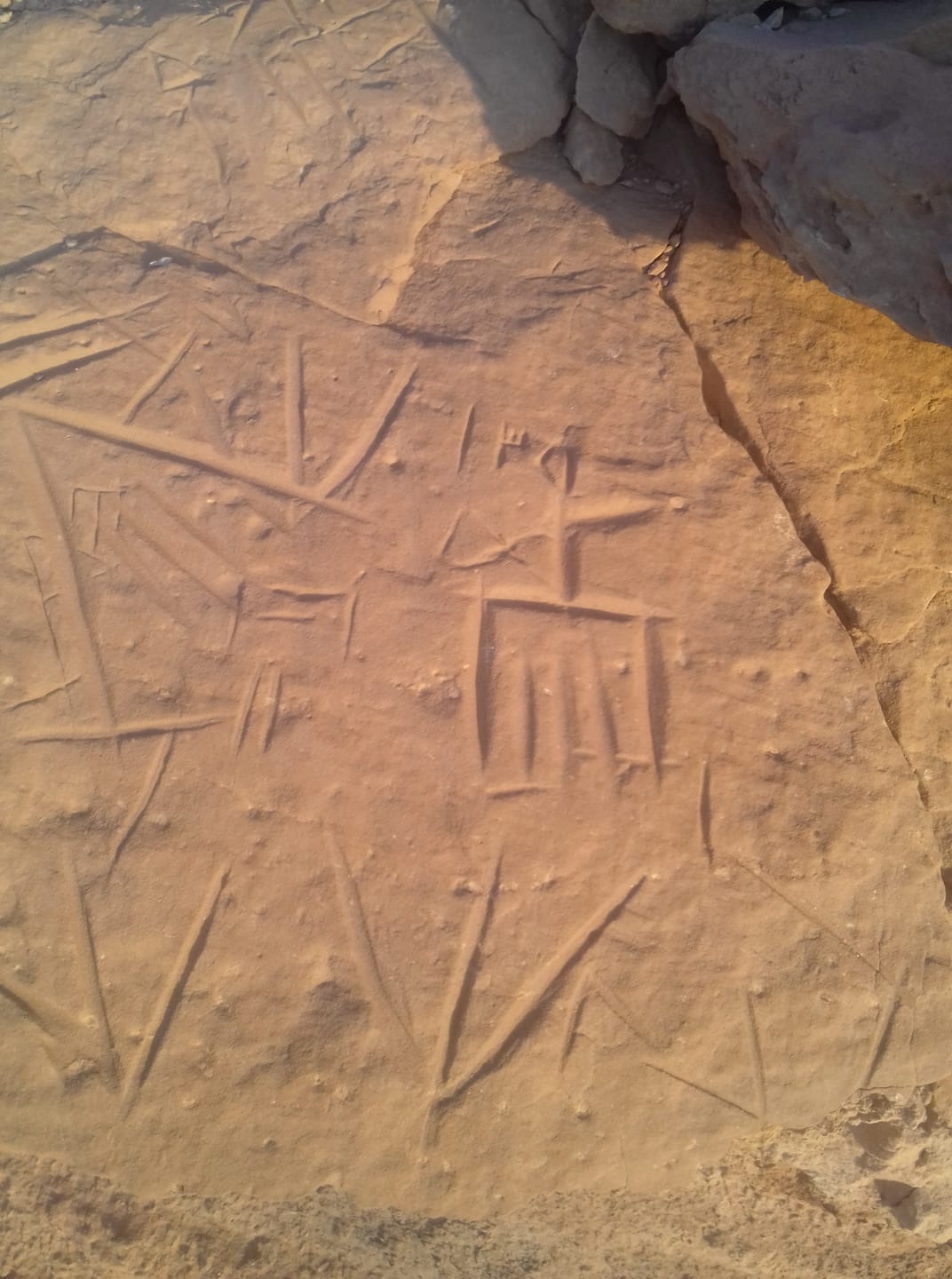
consecrated to the cult”. In Figure 4, Illustration 4, Ga Gyo “[Here] the House
of the Divinity of the cult”.
The Temple lands were recognize as a superior location. In
Figure 3, Illustration 3 we see Ka se gyo , “The narrow superior
entrance [to the Temple] is an Object consecrated to the Divinity”. It was also
seen as a place of rest as illustrated in Figure 4, Illustration 4, Gyo to
, “The Object consecrated to the Cult is a place of rest”. In general the
Temple grounds were considered Holy Ground, as noted in Figure 6, Illustration
6, Le gyo , “Indeed an area consecrated to the Divinity”.
The Temple inscription often call on the Believer to
su , make libations to Ko ‘God’: Su Ko ,
Offer the libation to God”, and in fact the Temple was seen as Ge su gba I , “to live as a
sacrifice fixed in the ground”.
The writers of the Temple text, made it clear that Believers
should lu , hold upright Fe ‘Love’. Sharing
Love to others was recognized as a
Libation to God. In Illustration 12, we see Ka fe
su I , “The zeal of Love is thine Libations”. As a result, Fe
‘Love’ was a major request of the cult followers. In Figure 4 Illustration 4,
we read Lu ge Fe Gyo ,
“Hold upright and sprout Love [ of the Object consecrated to the Divinity”. A
Temple Believer noted in Illustration 12, is I gyo gyo fe i ,
“Thine unblemished Divinity of the cult [is] Loved here”.It was at this Temple
the cult follower was to Fe po lu , “Pure Love Hold it upright.”
Another interesting term used in the Temple text is Ka
. Ka means ‘zeal’. . In Illustration 12, we see Ka fe su I
, “The zeal of Love is thine Libations” . It become visible that the Believer
felt the followers of the cult should be active worshippers of the cult.
The cult followers were working to further the cult and
belief in God because it was recognized as a mark of Admiration. Thusly we have
in Illustration Gyo pa pa be , “This Object of Respect [the Temple] consecrated
to the Divinity is a mark of Admiration and much subsistence”. The Believer was to present a character of Goodness
. In Illustration 13, we read li fe
yo pe I gyo , “Goodness, Love and the vast vital spirit [of the
Divinity] in the company of the Divinity of the cult”. A Good character was considered the normal behavior of the
adherent to the cult Po lu se , ‘Extensive superior Good’
(Illustration 8); and Fe li lu , “To desire to hold upright
moral approval (see Figure 3 Illustration 3).
In summary, the Temple text were meant to help the Believer
organize their response to existence. To these followers of the Temple the
Divinity was usually nameless and recognized as just Ko ‘God’.
Ko , God was not hidden. Temple cult followers
saw God as a living God. They did not not give a particular name to their
God,because it was assumed that everyone in the cult knew God. And God , to the
cult followers was ever present in the consciousness and world of the Believer,
and therefore since they knew God personally, they did not have to represent
their God iconographically, because he was alive in the heart of the Believer.
The Temple text allowed the Believer to communicate
intimately with God. The Temple text were meant to help the Believer organize
their response to everyday living. As a result, the text suggest that Temple
Believers did not need a priest as the intermediary between man and God.
Finally, the Temple text , were life manuscript, because
they sought from God guidance in communicating and interacting with your fellow
man. These text indicate that it was accepted by all, that God exist and was
known by every member of society. As a result, they did not have to give their
God a specific name. To the Temple Believer it was recognized that God was a
vital spirit infused inside each Believer.
References:
Pope,J.(2019). Figural Graffiti from the Meroitic Era on
Philae Island. In Along the Nile and Beyond, Eds Geoff Emberling
and Suzanne Davis. Kelsey Museum Publication 16, pp.71-86.
M. Desplanges,M. (1906). Origines des Populations Nigeriennes , Anthropologie ,17: pp.525-546.
Winters, C. (2013). Before
Egypt: The Maa Confederation, Africa?s First Civilization .
Winters, C. Archaeological Decipherment of Ancient
Writing Systems .
Winters, C. African Origin World Writing Systems
.
Below are the Old Temple Inscriptions.


 |
| Figure 4 |


 |
| Illustration 2 |


